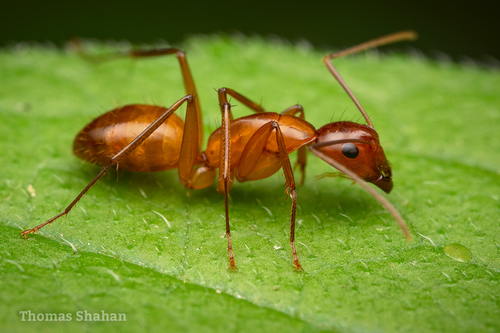


Chestnut Carpenter Ant
camponotus castaneus
The Chestnut Carpenter Ant (Camponotus castaneus) is a striking and robust species of ant known for its brilliant reddish-brown, glossy coloration. Unlike many other members of the carpenter ant genus that infamously excavate nests inside sound wooden structures, this species is much more down-to-earth. They prefer to build their intricate subterranean colonies in the soil, often hiding their entrances beneath stones, rotting logs, or thick leaf litter in deciduous forests. These industrious insects are predominantly nocturnal, venturing out under the cover of darkness to forage for sweet liquids and scavenge dead insects. Because they are not structural pests, they are completely harmless to human homes and serve as an important ecological cleanup crew in their native woodlands. Their impressive size and beautiful, uniform amber coloring make them a favorite find for naturalists and macro photographers exploring the forest floor.
Lebensraum: Found primarily in deciduous forests and woodland edges, they typically nest underground in the soil beneath rocks, rotting logs, or thick leaf litter.
Camponotus castaneus is one of the easiest carpenter ants to identify due to its uniform glossy, yellowish-red to chestnut-brown coloration across its entire body, including the head, thorax, and abdomen. Workers exhibit polymorphism, with minor workers being smaller and more slender, while major workers possess disproportionately large, powerful heads equipped with strong mandibles. They are among the largest ants in North America, with workers ranging from 7 to 10 millimeters, and queens reaching up to 16 millimeters in length. A fringe of sparse, golden hairs can often be seen on the abdomen under magnification, and reproductive individuals (alates) possess clear wings with distinct brownish veins.
Kategorie
InsektenSeltenheit
Common
Gefahr
1/5 · Sehr gering
Snaps
Mach den ersten Snap!
Their large, translucent reddish bodies make them a favorite among ant-keeping enthusiasts, who sometimes refer to them as the 'golden' or 'honey' carpenter ant.
Unlike the infamous Black Carpenter Ant, the Chestnut Carpenter Ant rarely nests in structural wood and poses almost no threat to human houses.
When a colony is disturbed, workers will rapidly tap their heads against the ground or tunnel walls to send vibrational warning signals to their nestmates.
Worker ants of this species are primarily nocturnal, meaning you are highly unlikely to see them foraging during the heat of the day.
They possess highly adapted sensory systems and circadian rhythms that allow them to efficiently navigate and forage in complete darkness, minimizing predation risks.
The colony produces workers of varying sizes and physical builds (minors, media, and majors), allowing them to efficiently divide labor from nursing brood to defending the nest.
Lacking a true stinger, these ants defend themselves by biting with powerful mandibles and spraying caustic formic acid from their abdomens into the wound.
They primarily feed on honeydew produced by sap-sucking insects, supplemented by scavenging dead invertebrates and foraging for natural plant juices.
Altersunterschiede: Larvae rely entirely on regurgitated, protein-rich liquid food provided by adult workers to facilitate their rapid growth.
Aphididae
Tends to these insects for their sugary honeydew excretions, offering them protection in return.
Dryocopus pileatus
Preyed upon by insectivorous woodland birds that forage on the ground and rotting logs.
Camponotus pennsylvanicus
Competes for foraging grounds and food resources within the same woodland habitats.
Für dieses Objekt sind noch keine Merkmal-Badges vergeben.
Noch keine Alternativnamen vorhanden.
Sammlungen für dieses Objekt erscheinen hier, wenn weitere Themen hinzugefügt werden.
Gefahr
1/5 · Sehr gering
Noch keine besonderen Sicherheitshinweise.
Der einfachste Weg, Chestnut Carpenter Ant zu bestimmen, ist die Verwendung der Naturführer-App Snappit.
1-2 cm
2-3 cm
0.000001-0.000005 kg
1-10 Jahre
They primarily feed on honeydew produced by sap-sucking insects, supplemented by scavenging dead invertebrates and foraging for natural plant juices.
Found primarily in deciduous forests and woodland edges, they typically nest underground in the soil beneath rocks, rotting logs, or thick leaf litter.
Foraging
Zoome hinein, um Cluster aufzulösen und zu sehen, wo dieses Objekt fotografiert wurde.
Neueste Snaps erscheinen hier, wenn neue Beobachtungen hinzukommen.

Virginia, US
Hier kann man sehen Asiatischer Marienkäfer und Gefleckte Laternentröger.
Führer anzeigen →

Virginia, US
Hier kann man sehen Asiatischer Marienkäfer und Gefleckte Laternentröger.
Führer anzeigen →














