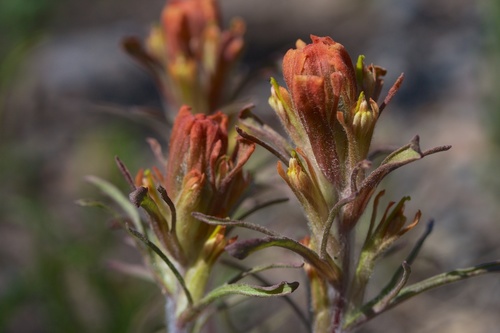


Cobwebby Paintbrush
castilleja arachnoidea
The Cobwebby Paintbrush, scientifically known as Castilleja arachnoidea, is a fascinating perennial herb that stands out in its alpine and subalpine habitats due to its distinctive appearance. Named for the dense, white, woolly hairs that cover its stems and leaves, resembling a spider's web, this plant is not only visually unique but also ecologically intriguing. It belongs to a genus famed for its vibrant, paintbrush-like blooms, though in this species, the hairs contribute significantly to its charm and defense. It is a hemiparasite, meaning it can photosynthesize its own food but also derives water and nutrients by tapping into the root systems of other plants, an adaptation that allows it to thrive in nutrient-poor, harsh environments.
Lebensraum: Found in high-altitude environments such as alpine meadows, rocky slopes, subalpine forests, and open dry areas, often with shallow, rocky soils.
The Cobwebby Paintbrush is characterized by its heavily woolly and cobweb-like (arachnoid) hairs that densely cover its stems and leaves, giving the plant a grayish-white, felted appearance. It typically grows as an upright plant, reaching heights of 10 to 40 centimeters. While the true flowers are small and inconspicuous, they are subtended by striking, leafy bracts that are often brightly colored in shades of red, orange, or yellow, creating the iconic 'paintbrush' effect that attracts pollinators. The overall form is often somewhat compact, forming clumps.
Kategorie
PflanzenSeltenheit
Common
Gefahr
1/5 · Sehr gering
Snaps
Mach den ersten Snap!
Its hemiparasitic nature allows it to colonize harsh, nutrient-poor soils by 'borrowing' nutrients from stronger neighboring plants, making it a clever survivor in tough mountain environments.
The 'arachnoidea' in its scientific name directly refers to the Greek word for spider, highlighting its unique cobweb-like hairs.
Unlike many plants, the vibrant 'flower' part of the Cobwebby Paintbrush is actually made up of colorful modified leaves called bracts, which surround the much smaller, true flowers.
This plant has evolved the ability to tap into the root systems of neighboring plants, primarily grasses and other forbs, to extract water and essential nutrients, supplementing its own photosynthetic production.
Dense, cobweb-like hairs cover the plant's stems and leaves, providing insulation against cold temperatures, reducing water loss in dry conditions, and potentially deterring herbivores.
Instead of showy petals, the modified leaves (bracts) surrounding the true flowers are brightly colored, acting as visual advertisements to attract hummingbirds and other insect pollinators.
The Cobwebby Paintbrush is a hemiparasitic plant, meaning it primarily produces its own food through photosynthesis (herbivore), but significantly supplements its nutrient and water intake by attaching to the roots of host plants (parasitism).
Bromus marginatus
The Cobwebby Paintbrush often forms haustorial connections with the roots of various grasses to obtain water and nutrients.
Selasphorus rufus
Hummingbirds are attracted to the brightly colored bracts and nectar of Castilleja species, acting as primary pollinators.
Bombus spp.
Various bee species visit the flowers for nectar and pollen, aiding in pollination.
Odocoileus hemionus
Mule deer may browse on the foliage, especially in areas where other forage is scarce, though it is not a primary food source.
Für dieses Objekt sind noch keine Merkmal-Badges vergeben.
Noch keine Alternativnamen vorhanden.
Sammlungen für dieses Objekt erscheinen hier, wenn weitere Themen hinzugefügt werden.
Gefahr
1/5 · Sehr gering
Noch keine besonderen Sicherheitshinweise.
Der einfachste Weg, Cobwebby Paintbrush zu bestimmen, ist die Verwendung der Naturführer-App Snappit.
10-40 cm
0.01-0.05 kg
1-5 Jahre
The Cobwebby Paintbrush is a hemiparasitic plant, meaning it primarily produces its own food through photosynthesis (herbivore), but significantly supplements its nutrient and water intake by attaching to the roots of host plants (parasitism).
Found in high-altitude environments such as alpine meadows, rocky slopes, subalpine forests, and open dry areas, often with shallow, rocky soils.
Parasitism
50-150
Zoome hinein, um Cluster aufzulösen und zu sehen, wo dieses Objekt fotografiert wurde.
Neueste Snaps erscheinen hier, wenn neue Beobachtungen hinzukommen.








_Colocasia_esculenta_-_Les_Martels%2C_Giroussens_Tarn.jpg&width=800)