

Common Starlily
leucocrinum montanum
The Common Starlily, scientifically known as Leucocrinum montanum, is a striking perennial wildflower native to the western United States. Emerging in early spring, often shortly after the snow melts, this delicate plant thrives in sagebrush scrub, sandy plains, and open pine forests. It is highly prized by nature enthusiasts for its pure white, star-shaped blooms that appear to burst directly from the soil without a visible stem. As one of the earliest bloomers in its arid habitat, it serves as a welcome sign of spring and an important nectar source for early-season pollinators.
Lebensraum: Found in sandy plains, sagebrush deserts, and dry, open pine forests across western North America.
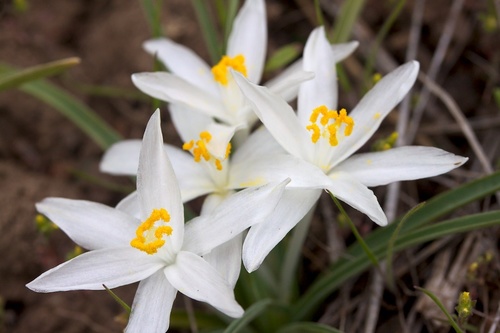
Leucocrinum montanum forms a low-growing, stemless tuft of narrow, grass-like leaves that reach up to 15 centimeters in length. Nestled in the center of the foliage are deeply fragrant, brilliant white, star-like flowers with six distinct tepals and striking yellow stamens. Because the ovary is located entirely underground, the flowers sit almost flush with the earth, giving the plant a unique, stemless appearance that makes it easily identifiable against the sandy or rocky soils where it grows.
Kategorie
PflanzenSeltenheit
Common
Gefahr
1/5 · Sehr gering
Snaps
Mach den ersten Snap!
Because its seeds develop completely underground, the Common Starlily relies on soil movement or burrowing insects to disperse its offspring.
Despite being called a 'lily' and previously classified in the Liliaceae family, it is now placed in the Asparagaceae family, making it a distant relative of garden asparagus.
The flowers are incredibly fragrant, often described as having a sweet, potent scent that draws in pollinators from surprisingly long distances.
The plant's ovary is located below ground, meaning its seeds develop safely hidden from surface herbivores, freezing temperatures, and extreme weather.
It possesses a network of deep, thick roots that allow it to store essential water and nutrients, ensuring its survival in arid and sandy environments.
Adapted to bloom very early in the spring, it rapidly takes advantage of transient snowmelt moisture before the hot, dry summer sets in.
Like most plants, the Common Starlily produces its own food through photosynthesis.
Osmia lignaria
Mason bees are early spring pollinators that visit the Common Starlily for nectar and pollen.
Odocoileus hemionus
Mule deer may occasionally graze on the emerging foliage in early spring when other food is scarce.
Thomomys talpoides
Pocket gophers occasionally feed on the thick, starchy underground roots of the starlily.
Für dieses Objekt sind noch keine Merkmal-Badges vergeben.
Noch keine Alternativnamen vorhanden.
Sammlungen für dieses Objekt erscheinen hier, wenn weitere Themen hinzugefügt werden.
Gefahr
1/5 · Sehr gering
Noch keine besonderen Sicherheitshinweise.
Der einfachste Weg, Common Starlily zu bestimmen, ist die Verwendung der Naturführer-App Snappit.
5-15 cm
3-10 Jahre
Like most plants, the Common Starlily produces its own food through photosynthesis.
Found in sandy plains, sagebrush deserts, and dry, open pine forests across western North America.
Zoome hinein, um Cluster aufzulösen und zu sehen, wo dieses Objekt fotografiert wurde.
Neueste Snaps erscheinen hier, wenn neue Beobachtungen hinzukommen.