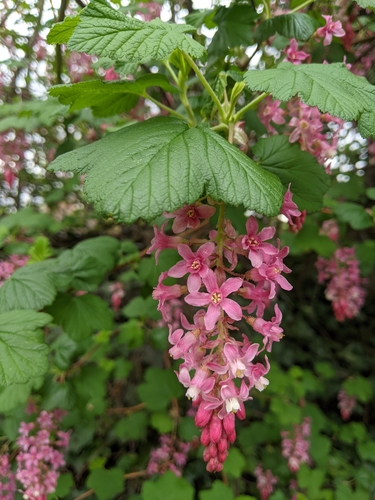


Currants And Gooseberries
ribes
The genus Ribes, commonly known as currants and gooseberries, represents a diverse group of deciduous shrubs prized both for their ecological value and delicious, tart berries. Found throughout the temperate regions of the Northern Hemisphere, these hardy woody plants are notable for their deeply lobed leaves, delicate hanging flowers, and translucent, jewel-like fruits that come in vibrant shades of red, black, yellow, and green. Historically, they have played an important role in traditional diets and backyard gardens, though their cultivation was once federally restricted in certain areas due to their role as an alternate host for white pine blister rust. Today, they remain a beloved sight for hikers and gardeners alike, offering a burst of color and a vital food source for local wildlife.
Lebensraum: Found in cool, temperate woodlands, forest edges, moist ravines, and montane thickets.
These shrubs typically grow between 50 and 250 centimeters tall and are characterized by their alternate, palmately lobed leaves resembling miniature maple leaves. Gooseberry species are usually armed with sharp, stiff spines at the stem nodes, whereas currants are spineless. Their small, bell-shaped flowers dangle in drooping clusters called racemes, varying in color from pale green to soft pink or bright red. In mid-to-late summer, they produce small, round, translucent berries, often marked with longitudinal stripes, which hang in delicate clusters or grow singly along the branches.
Kategorie
PflanzenSeltenheit
Common
Gefahr
1/5 · Sehr gering
Snaps
Mach den ersten Snap!
Black currants are famously rich in Vitamin C, containing up to four times the concentration found in oranges.
In the early 20th century, the United States banned the cultivation of Ribes to protect the timber industry, as the plants host a fungus deadly to white pines.
The distinction between gooseberries and currants is easy: gooseberry bushes have thorns, while currant bushes are completely smooth.
Gooseberry species utilize sharp nodal spines along their branches to deter large herbivores from grazing on their foliage and fruit.
They form beneficial relationships with mycorrhizal fungi in the soil, enhancing nutrient and water uptake in dense forest soils.
These plants can survive severe winter temperatures by entering a deep physiological dormancy, allowing them to thrive in sub-arctic conditions.
As photosynthetic plants, they generate their own organic compounds using sunlight, water, carbon dioxide, and essential soil minerals.
Turdus migratorius
Eats the ripe berries and disperses the seeds across new habitats.
Cronartium ribicola
Uses Ribes species as an obligate alternate host to complete its complex lifecycle, causing rust disease.
Apis mellifera
Pollinates the spring blossoms while collecting nectar and pollen.
Für dieses Objekt sind noch keine Merkmal-Badges vergeben.
Noch keine Alternativnamen vorhanden.
Sammlungen für dieses Objekt erscheinen hier, wenn weitere Themen hinzugefügt werden.
Gefahr
1/5 · Sehr gering
Noch keine besonderen Sicherheitshinweise.
Der einfachste Weg, Currants And Gooseberries zu bestimmen, ist die Verwendung der Naturführer-App Snappit.
50-250 cm
10-30 Jahre
As photosynthetic plants, they generate their own organic compounds using sunlight, water, carbon dioxide, and essential soil minerals.
Found in cool, temperate woodlands, forest edges, moist ravines, and montane thickets.
Zoome hinein, um Cluster aufzulösen und zu sehen, wo dieses Objekt fotografiert wurde.
Neueste Snaps erscheinen hier, wenn neue Beobachtungen hinzukommen.



.jpg)










_Lathyrus_pratensis-_Habit.jpg&width=800)