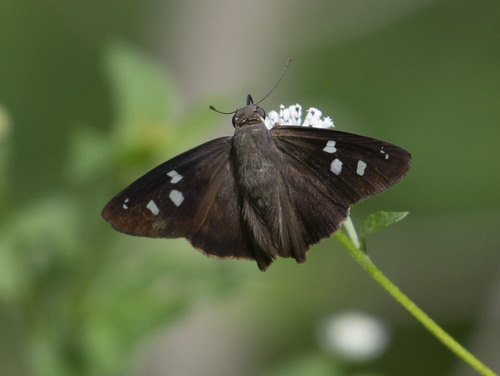


Florida Hammock Skipper
polygonus histrio
The Florida Hammock Skipper (Polygonus histrio) is a fascinating butterfly species native to the subtropical hammocks and coastal forests of Florida and the Caribbean. Known for its rapid, darting flight pattern characteristic of the Hesperiidae family, this skipper is a master of camouflage when at rest. It typically zips through shaded forest understories, searching for nectar sources or larval host plants. Unlike many colorful butterflies, it sports a more subdued, elegant palette of deep browns and purples that blend seamlessly with decaying leaves and bark. Because of its elusive nature and specific habitat requirements, spotting a Florida Hammock Skipper is a rewarding challenge for wildlife enthusiasts. They are highly dependent on native hardwood hammock habitats, making them sensitive indicators of local ecosystem health and forest conservation.
Lebensraum: Found in dense hardwood hammocks, maritime forests, and coastal shrublands where its primary host plants grow.
This medium-sized skipper has a wingspan of approximately 4 to 6 cm. The upperside of the wings is a dark, velvety blackish-brown, often showing a subtle purplish sheen in direct light. The forewings feature several translucent, glassy-white spots arranged in a distinct pattern. Underneath, the wings display a mottled pattern of purplish-brown and dark grey, providing excellent camouflage against tree bark. Its body is robust and hairy, with large eyes and relatively short, hooked antennae characteristic of skippers.
Kategorie
InsektenSeltenheit
Common
Gefahr
1/5 · Sehr gering
Snaps
Mach den ersten Snap!
The caterpillar of this species constructs a custom-built sleeping bag by folding a leaf over itself and gluing it shut with silk.
They are exceptionally fast fliers, often appearing as a mere blur to human observers as they dart from branch to branch.
Unlike typical butterflies, skippers have robust, moth-like bodies and uniquely hooked antennae rather than clubbed ones.
Features extremely rapid, erratic flight patterns that allow it to escape predators and navigate dense, tangled forest undergrowth with ease.
The mottled purplish-grey underside of its wings perfectly mimics tree bark and dead leaves when resting with wings folded.
Caterpillars cut and fold pieces of host plant leaves, binding them with silk to create protective individual sleeping bags.
Adults feed entirely on floral nectar from various forest flowers, while the caterpillar larvae feed exclusively on the leaves of specific host trees.
Altersunterschiede: Larvae strictly consume foliage of the host tree, whereas adults forage exclusively on liquid flower nectar.
Piscidia piscipula
Acts as the primary larval host plant where females lay eggs and caterpillars feed on foliage.
Polistes carolina
Preys upon the caterpillar larvae found sheltering in folded leaves.
Bidens alba
Provides a primary, high-energy nectar source for foraging adult skippers.
Für dieses Objekt sind noch keine Merkmal-Badges vergeben.
Noch keine Alternativnamen vorhanden.
Sammlungen für dieses Objekt erscheinen hier, wenn weitere Themen hinzugefügt werden.
Gefahr
1/5 · Sehr gering
Noch keine besonderen Sicherheitshinweise.
Der einfachste Weg, Florida Hammock Skipper zu bestimmen, ist die Verwendung der Naturführer-App Snappit.
2-3 cm
4-6 cm
0.0001-0.0003 kg
25 km/h
Adults feed entirely on floral nectar from various forest flowers, while the caterpillar larvae feed exclusively on the leaves of specific host trees.
Found in dense hardwood hammocks, maritime forests, and coastal shrublands where its primary host plants grow.
Foraging
Zoome hinein, um Cluster aufzulösen und zu sehen, wo dieses Objekt fotografiert wurde.
Neueste Snaps erscheinen hier, wenn neue Beobachtungen hinzukommen.









.jpg&width=800)


