

Fremont Barberry
berberis fremontii
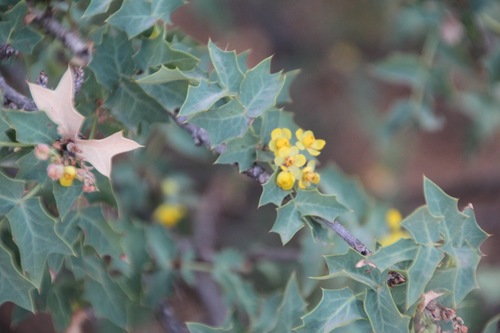
Fremont Barberry (Berberis fremontii) is a striking, evergreen shrub native to the arid desert regions and pinyon-juniper woodlands of the American Southwest. Known for its tough, spiny leaves and brilliant seasonal displays, this resilient plant plays a vital ecological role in its harsh native habitat. In spring, it bursts into bloom with bright yellow flowers, which eventually give way to small, fleshy berries that transition from yellow to red and finally to a deep bluish-purple, attracting a wide variety of desert wildlife. Beyond its ecological value, Fremont Barberry has a rich cultural history. Indigenous peoples of the Southwest historically utilized its wood and roots to produce a vibrant yellow dye, while the tart berries were harvested for food and traditional medicinal purposes. Its ability to thrive in poor, rocky soils and survive extreme droughts makes it a true marvel of desert adaptation and a prized find for hikers and nature enthusiasts exploring the high deserts.
Lebensraum: Found in dry, rocky canyons, gravelly slopes, and pinyon-juniper woodlands of the southwestern United States at elevations between 1,000 and 2,500 meters.
This erect, multi-branched evergreen shrub typically grows between 100 to 400 centimeters in height. Its most distinctive feature is its holly-like leaves, which are pinnately compound, stiff, and armed with sharp, spinose teeth along the margins. The leaves exhibit a dusty, glaucous blue-green to grayish-green hue, helping the plant conserve water. In spring, dense clusters of bright yellow, six-petaled flowers bloom near the branch tips. These flowers develop into dry-to-fleshy, inflated berries about 1 to 1.5 centimeters in diameter, which mature from yellowish-green to deep dark blue or purple-black.
Kategorie
PflanzenSeltenheit
Common
Gefahr
1/5 · Sehr gering
Snaps
Mach den ersten Snap!
Despite their extremely tart taste, the berries were historically used by indigenous peoples and early settlers to make jellies, jams, and traditional beverages.
The roots and inner bark of Fremont Barberry contain berberine, which produces a bright yellow dye traditionally used by Native Americans to color baskets and wool.
The sharp, holly-like leaves are not just for defense; their bluish-gray waxy coating acts like natural sunscreen, reflecting intense desert sunlight to keep the plant cool.
Thick, leathery, and waxy leaves drastically reduce water loss through transpiration and deter herbivores with their sharp, spiny margins.
While largely evergreen, the plant can shed a portion of its leaves during extreme drought periods to conserve vital water and resources.
Synthesizes berberine, a bitter-tasting, antimicrobial chemical compound in its tissues that deters herbivores and protects against pathogens.
As a photoautotrophic plant, Fremont Barberry produces its own food through photosynthesis, utilizing sunlight, carbon dioxide, water, and soil minerals.

Phainopepla nitens
Feeds on the ripe berries and acts as a key seed disperser in desert environments.
Neotoma lepida
Utilizes the spiny branches for nesting material and consumes the foliage and berries.
Apis mellifera
Visits the yellow flowers in spring for nectar and pollen, acting as a primary pollinator.
Für dieses Objekt sind noch keine Merkmal-Badges vergeben.
Noch keine Alternativnamen vorhanden.
Sammlungen für dieses Objekt erscheinen hier, wenn weitere Themen hinzugefügt werden.
Gefahr
1/5 · Sehr gering
Noch keine besonderen Sicherheitshinweise.
Der einfachste Weg, Fremont Barberry zu bestimmen, ist die Verwendung der Naturführer-App Snappit.
100-400 cm
20-100 Jahre
As a photoautotrophic plant, Fremont Barberry produces its own food through photosynthesis, utilizing sunlight, carbon dioxide, water, and soil minerals.
Found in dry, rocky canyons, gravelly slopes, and pinyon-juniper woodlands of the southwestern United States at elevations between 1,000 and 2,500 meters.
Zoome hinein, um Cluster aufzulösen und zu sehen, wo dieses Objekt fotografiert wurde.
Neueste Snaps erscheinen hier, wenn neue Beobachtungen hinzukommen.