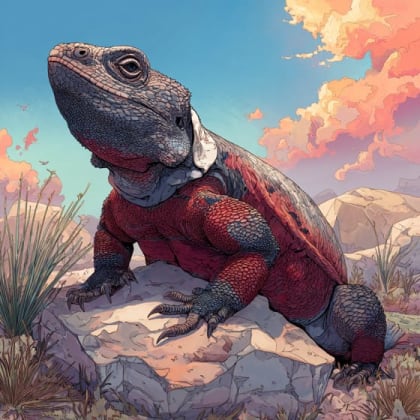
Grey-Banded Kingsnake
lampropeltis alterna
The Grey-Banded Kingsnake is a beautiful snake with striking gray and black bands. It loves to explore its surroundings and is a great friend to have in your backyard!
Lebensraum: Rocky and mountainous areas, often in dry regions.
The Grey-Banded Kingsnake has a slender body with striking patterns of grey or tan scales, boldly marked by distinct, darker bands, often reddish-orange, outlined in black. Its head is usually dark with lighter markings, blending seamlessly with its body.
Kategorie
ReptilienSeltenheit
Common
Gefahr
1/5 · Sehr gering
Snaps
Mach den ersten Snap!
They are amazing climbers, often scaling rocky cliffs to find warm basking spots!
This snake's scientific name, 'alterna', refers to its alternating colorful band patterns!
Threatened? They'll shake their tail like a rattlesnake, but they're not venomous!
Young kingsnakes eat small lizards; adults prefer rodents and other snakes.
Grey-Banded Kingsnake can squeeze its prey tightly using powerful constriction, making it easier to eat.
Grey-Banded Kingsnake has natural resistance to some snake venoms, allowing them to eat other snakes.
Grey-Banded Kingsnake has banded patterns that help them blend perfectly with rocky desert environments.
A stealthy hunter, it dines on rodents, lizards, and even other snakes it catches!
Altersunterschiede: Young snakes eat smaller lizards and insects, while adults prey on rodents and other snakes.
Crotalus atrox
Preys on this venomous rattlesnake species.
Peromyscus maniculatus
A common prey item in its natural habitat.
Buteo jamaicensis
Young snakes can be prey for these birds.
Canis latrans
An opportunistic predator of various snakes.
Einzelgänger leben den größten Teil ihres Lebens allein und interagieren mit Artgenossen nur zur Paarung oder zur Aufzucht der Jungen.
Farbenfroh beschreibt Organismen oder Objekte, die eine große Vielfalt an leuchtenden und deutlich erkennbaren Farben aufweisen.
Dieses Merkmal kennzeichnet Organismen, deren Ernährung vollständig oder hauptsächlich aus tierischem Gewebe besteht.
Nachtaktive Tiere sind hauptsächlich in den Nachtstunden aktiv und ruhen oder schlafen normalerweise tagsüber.
Gefahr
1/5 · Sehr gering
Always observe snakes from a distance and never attempt to touch them.
60-100 cm
0.2-0.5 kg
10-20 Jahre
2 km/h
A stealthy hunter, it dines on rodents, lizards, and even other snakes it catches!
Rocky and mountainous areas, often in dry regions.
Ambush
3-13
Zoome hinein, um Cluster aufzulösen und zu sehen, wo dieses Objekt fotografiert wurde.
Neueste Snaps erscheinen hier, wenn neue Beobachtungen hinzukommen.