Italian arum
Arum italicum
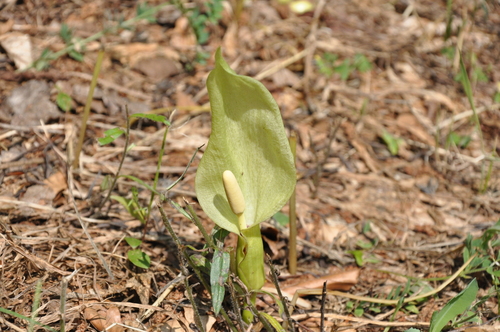
The Italian arum is a unique plant with large, arrow-shaped leaves and a striking flower that looks like a hood. It grows in shady places and can be found in gardens and woodlands.
Lebensraum: Woodlands
The Italian arum has glossy, dark green, arrow-shaped leaves with prominent cream or silver veins, often appearing in autumn. Its unique flower consists of a large, pale green-yellow, hood-like spathe surrounding a yellow flower spike, followed by striking clusters of bright red-orange berries.
Kategorie
PflanzenSeltenheit
Common
Gefahr
3/5 · Mittel
Snaps
Mach den ersten Snap!
It smells like rotting meat or dung to trick flies into visiting its flowers!
Its bright red-orange berries look tasty but are super poisonous if eaten!
The Italian arum's leaves sprout in fall and stay green all through the winter!
The plant's special flower can actually make its own heat, like a tiny heater!
Italian arum flowers can warm themselves up to attract tiny flies and beetles, helping them pollinate the plant.
The plant emits a foul, carrion-like odor that draws in specific insect pollinators, helping it reproduce.
Italian arum has irritating calcium oxalate crystals in all its parts, protecting it from most hungry animals.
Psychoda alternata
Attracted by warmth and smell

Arion ater
Can graze on the plant's leaves
Turdus merula
Disperses seeds by consuming berries
Blütenpflanzen sind alle Pflanzen, die als Teil ihres Fortpflanzungszyklus Blüten bilden.
Laubabwerfende Pflanzen werfen regelmäßig all ihre Blätter ab, typischerweise im Herbst oder in Trockenzeiten.
Zierpflanzen werden hauptsächlich wegen ihres ästhetischen Reizes angebaut und verschönern Landschaften und Gärten mit ihrem attraktiven Laub, ihren Blüten oder ihrer Form.
Schattenverträgliche Pflanzen sind an das Wachstum und Gedeihen in Bereichen mit wenig Licht angepasst und benötigen weniger direkte Sonneneinstrahlung.

Waldlebensräume sind terrestrische Lebensräume, die von dichtem Baumbestand dominiert werden und eine große Vielfalt an Pflanzen- und Tierarten beherbergen.
Noch keine Alternativnamen vorhanden.
Gefahr
3/5 · Mittel
Don't touch or eat any part of the Italian arum, as it can make you feel sick.
15-45 cm
30-60 cm
15-25 cm
Frühling
Nein
Hoch
Mehrjährig
Insekten
Zoome hinein, um Cluster aufzulösen und zu sehen, wo dieses Objekt fotografiert wurde.
Neueste Snaps erscheinen hier, wenn neue Beobachtungen hinzukommen.