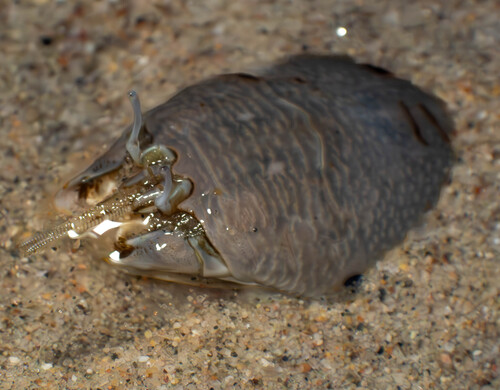


Pacific Sand Crab
emerita analoga
The Pacific Sand Crab (Emerita analoga), also known as the mole crab, is a small, fascinating crustacean that thrives in the high-energy, turbulent swash zone of sandy beaches along the Pacific coast. Spending its entire life buried just beneath the surface of the sand, this remarkable creature moves up and down the shoreline with the shifting tides, staying in the wet, soft sand where waves continuously crash. It is highly valued as an ecological indicator of beach health and serves as a vital link in the marine food web, feeding countless coastal birds, surf fish, and sea otters. Watching a group of sand crabs rapidly disappear backward into the wet sand as a wave recedes is one of the most delightful and iconic experiences for beachgoers of all ages.
Lebensraum: Found in the intertidal swash zone of sandy ocean beaches, constantly migrating with the shifting tides.
The Pacific Sand Crab features a smooth, egg-shaped, barrel-like carapace that lacks a tail or claws, making it perfectly adapted for burrowing. Its coloration is a cryptic, sandy gray-brown to off-white, allowing it to blend seamlessly into its sandy environment. Females are significantly larger than males, reaching lengths of up to 3.5 centimeters, while males remain around 2 centimeters. They possess highly specialized, feathery antennae used for filter feeding, and flat, paddle-like legs designed for backward burrowing rather than walking.
Kategorie
AnimalSeltenheit
Common
Gefahr
1/5 · Sehr gering
Snaps
Mach den ersten Snap!
Female sand crabs carry bright, neon-orange egg masses under their abdomens, which can contain up to 45,000 eggs at a time.
Sand crabs are highly sensitive to toxins and are widely used by scientists as an indicator species to monitor the health and pollution levels of sandy beaches.
They can only crawl and burrow backward; they are completely incapable of walking forward.
Using specialized paddle-like legs, the sand crab can bury itself backward into wet sand in under two seconds to escape predators and wave action.
Unfurls long, plume-like antennae into the retreating wave wash to trap microscopic plankton and detritus.
Rides waves up and down the beach slope to remain in the moist swash zone as tides change throughout the day.
Feeds primarily by filtering microscopic food particles, such as phytoplankton and detritus, from retreating waves using feathery antennae.
Altersunterschiede: Larvae feed on smaller planktonic organisms in the open ocean, while adults filter-feed on benthic and pelagic microflora in the sandy surf.

Calidris alba
Flocks of sanderlings forage along the wet sand, using their beaks to probe and consume sand crabs.
Amphistichus argenteus
This surf-dwelling fish patrols the shallow breaking waves to feed heavily on sand crabs.
Enhydra lutris nereis
Sea otters occasionally forage close to the sandy shoreline to feed on larger female sand crabs.
Für dieses Objekt sind noch keine Merkmal-Badges vergeben.
Noch keine Alternativnamen vorhanden.
Sammlungen für dieses Objekt erscheinen hier, wenn weitere Themen hinzugefügt werden.
Gefahr
1/5 · Sehr gering
Noch keine besonderen Sicherheitshinweise.
Der einfachste Weg, Pacific Sand Crab zu bestimmen, ist die Verwendung der Naturführer-App Snappit.
1-4 cm
0.001-0.02 kg
2-3 Jahre
Feeds primarily by filtering microscopic food particles, such as phytoplankton and detritus, from retreating waves using feathery antennae.
Found in the intertidal swash zone of sandy ocean beaches, constantly migrating with the shifting tides.
Filtering
1000-45000
Zoome hinein, um Cluster aufzulösen und zu sehen, wo dieses Objekt fotografiert wurde.
Neueste Snaps erscheinen hier, wenn neue Beobachtungen hinzukommen.



