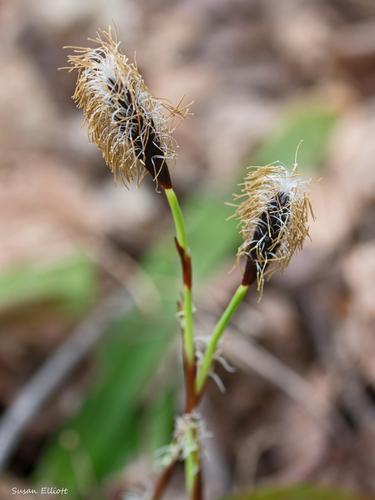


Plantainleaf Sedge
carex plantaginea
Plantainleaf Sedge (Carex plantaginea) is a striking perennial sedge native to the rich, moist deciduous forests of eastern North America. Often referred to as the "seersucker sedge" due to the unique dimpled texture of its unusually broad leaves, this plant brings an exquisite structural elegance to the forest floor. Unlike many of its narrow-leaved relatives, its foliage is highly ornamental, evergreen in milder climates, and strongly resembles the leaves of broadleaf plantains. In early spring, before the canopy trees leaf out, this species is among the first to bloom, sending up distinctive, dark purple-black culms tipped with creamy yellow staminate flowers. This early activity makes it a vital resource for emerging spring pollinators and adds a dramatic splash of color to the waking woodlands.
Lebensraum: Found in rich, moist, deciduous woodlands, particularly on lime-rich slopes, rocky ravines, and near shady streams.
This sedge forms neat, arching clumps reaching up to 30 to 45 cm tall. Its most identifying feature is its broad, strap-like, lime-green to deep green leaves (up to 3 cm wide) which have three prominent veins and a distinctly puckered, "seersucker" texture. The bases of the leaves are wrapped in deep, wine-red or purple sheaths. In early spring, erect, leafless flowering stalks rise above the foliage, displaying dark burgundy to nearly black bracts and spikelets, contrasted by pale yellow, feathery stamens that emerge from the top.
Kategorie
PflanzenSeltenheit
Common
Gefahr
1/5 · Sehr gering
Snaps
Mach den ersten Snap!
Its striking, dark purple flower spikes appear very early in spring, sometimes emerging right through the melting forest snow.
The common name 'seersucker sedge' comes from the puckered texture of its leaves, which closely resembles the crinkled seersucker fabric.
Unlike most sedges which have narrow, grass-like leaves, Plantainleaf Sedge has exceptionally broad leaves that can reach over an inch in width.
The unique, puckered surface of the broad leaves maximizes surface area to capture limited sunlight in the dim forest understory.
Initiates rapid growth and flowering in early spring, utilizing the brief window of high sunlight before the deciduous forest canopy closes.
Accumulates deep purple pigments in its basal sheaths and flower bracts to absorb heat and protect delicate tissues during cold early spring days.
As a photoautotroph, this plant manufactures its own energy from sunlight, water, and carbon dioxide through the process of photosynthesis.
Aphaenogaster rudis
Ants disperse the seeds of the sedge, attracted by the nutrient-rich elaiosomes attached to the achenes.
Euphyes vestris
Caterpillars of this butterfly feed on the foliage of various woodland sedges.
Odocoileus virginianus
Occasionally grazes on the evergreen foliage during late winter when other food sources are scarce.
Für dieses Objekt sind noch keine Merkmal-Badges vergeben.
Noch keine Alternativnamen vorhanden.
Sammlungen für dieses Objekt erscheinen hier, wenn weitere Themen hinzugefügt werden.
Gefahr
1/5 · Sehr gering
Noch keine besonderen Sicherheitshinweise.
Der einfachste Weg, Plantainleaf Sedge zu bestimmen, ist die Verwendung der Naturführer-App Snappit.
20-45 cm
5-15 Jahre
As a photoautotroph, this plant manufactures its own energy from sunlight, water, and carbon dioxide through the process of photosynthesis.
Found in rich, moist, deciduous woodlands, particularly on lime-rich slopes, rocky ravines, and near shady streams.
Zoome hinein, um Cluster aufzulösen und zu sehen, wo dieses Objekt fotografiert wurde.
Neueste Snaps erscheinen hier, wenn neue Beobachtungen hinzukommen.














.JPG&width=800)
