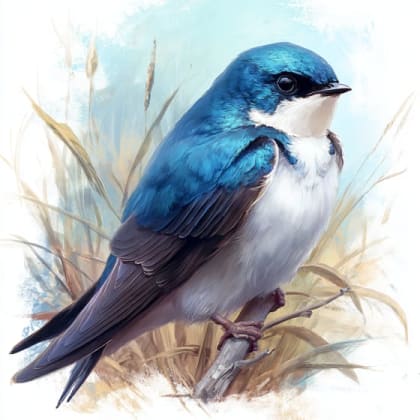
Reed Bunting
Emberiza schoeniclus
The Reed Bunting is a small bird that loves to live near wetlands and tall grasses. It has a lovely song and can often be seen perched on reeds, singing to attract a mate.
Lebensraum: Wetlands
The Reed Bunting has a streaky brown back and reddish flanks. Breeding males are easily identified by their striking black head and throat, contrasted with a clean white moustachial stripe and collar. Females and winter males are duller with a streaky brown head.
Kategorie
VögelSeltenheit
Common
Gefahr
1/5 · Sehr gering
Snaps
Mach den ersten Snap!
Male Reed Buntings sometimes have two mates at once!
Some Reed Buntings fly all the way to North Africa for winter!
Their nests are so well hidden low in the reeds, they are almost invisible!
They often sing from the very top of a swaying reed, like a tiny conductor!
Reed Buntings can skillfully navigate dense reedbeds because of their agile bodies that help them find food and shelter.
Male Reed Buntings have striking plumage changes because of hormones that help them attract mates during breeding season.
Reed Buntings can switch their diet because of their versatile beak that helps them eat seeds in winter and insects in summer.
Reed Buntings can migrate long distances because of their strong wings that help them escape harsh northern winters.
Feasting on seeds and insects, they adapt their menu with the seasons.
Altersunterschiede: Young birds mainly eat protein-rich insects for growth; adults have a more varied diet.

Typha latifolia
Provides nesting sites and cover from predators.

Accipiter nisus
Small raptors like sparrowhawks prey on adult buntings.
Felis catus
Domestic cats are opportunistic predators of ground-nesting birds.
Phalaris arundinacea
Eats seeds from this grass and uses it for shelter.
Gefiedert beschreibt Tiere, hauptsächlich Vögel, die ein Federkleid besitzen.
Soziale Tiere leben in organisierten Gruppen und kooperieren, um ihr Überleben zu sichern, beispielsweise bei der Nahrungssuche, Verteidigung und Aufzucht der Jungen.
Singende Tiere erzeugen komplexe Lautäußerungen, oft um Partner anzulocken, ihr Revier zu verteidigen oder innerhalb ihrer Art zu kommunizieren.
Dieses Merkmal kennzeichnet Organismen, deren Nahrung hauptsächlich aus Insekten und anderen kleinen Wirbellosen besteht.

Dieses Lebensraummerkmal kennzeichnet Arten, die in Feuchtgebieten vorkommen. Dies sind Landflächen, die dauerhaft oder saisonal mit Wasser gesättigt sind, darunter Marschland, Sümpfe und Moore.

Tagaktive Tiere sind hauptsächlich bei Tageslicht aktiv und ruhen oder schlafen in der Regel nachts.
Noch keine Alternativnamen vorhanden.
Gefahr
1/5 · Sehr gering
Enjoy watching birds from a distance and don't disturb their nests.
13.5-16 cm
21-27 cm
0.013-0.02 kg
2-5 Jahre
40 km/h
Feasting on seeds and insects, they adapt their menu with the seasons.
Wetlands
Foraging
Zoome hinein, um Cluster aufzulösen und zu sehen, wo dieses Objekt fotografiert wurde.
Neueste Snaps erscheinen hier, wenn neue Beobachtungen hinzukommen.