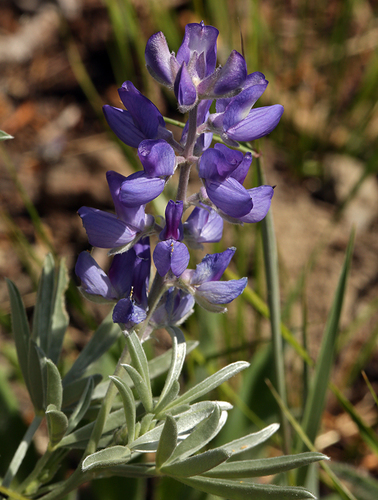


Satin Lupine
lupinus obtusilobus
The Satin Lupine, scientifically known as Lupinus obtusilobus, is a beautiful and ecologically significant perennial herb native to western North America. This species is a vibrant component of montane and subalpine ecosystems, adorning open slopes and meadows with its striking flower spikes. Beyond its aesthetic appeal, the Satin Lupine plays a crucial role in its habitat as a nitrogen-fixing plant, enriching the soil and supporting other plant life in often nutrient-poor environments. Its resilience and unique adaptations make it a fascinating subject for nature enthusiasts and a vital part of its alpine and subalpine communities. It exemplifies the intricate balance and beauty of high-altitude flora.
Lebensraum: Typically found in well-drained, often rocky or sandy soils of montane and subalpine meadows, open slopes, and forest clearings.
Satin Lupine typically grows as an erect to sprawling perennial herb, reaching heights of 10 to 60 centimeters. Its most striking feature is its dense racemes of showy, pea-like flowers, which are usually a vibrant blue to purple, though sometimes pinkish or whitish. The leaves are palmate, composed of 5 to 9 leaflets, and often covered in fine, silky hairs, giving them a distinctive silvery or 'satin' sheen. The stems are usually robust and can be leafy, contributing to its bushy appearance.
Kategorie
PflanzenSeltenheit
Common
Gefahr
1/5 · Sehr gering
Snaps
Mach den ersten Snap!
Belongs to the legume family (Fabaceae), known for its ability to enrich soil through nitrogen fixation, making it a pioneer species in disturbed areas.
Its seeds are dispersed explosively when the mature pods dry and split open, flinging them several feet away from the parent plant.
Satin Lupine contains alkaloids that make it toxic to livestock if consumed in large quantities, serving as a natural defense mechanism against herbivores.
The name 'Lupinus' is derived from the Latin word 'lupus' meaning wolf, possibly due to a historical misconception that lupines 'wolfed' nutrients from the soil, when they actually improve it.
Through a symbiotic relationship with Rhizobium bacteria in its root nodules, Satin Lupine converts atmospheric nitrogen into a usable form for itself and enriches the surrounding soil, a crucial process in nutrient-limited environments.
The plant produces a variety of alkaloids, which are chemical compounds that deter many herbivores from grazing on its leaves and seeds, providing a natural defense mechanism.
Satin Lupine possesses a deep taproot system, allowing it to access water from deeper soil layers and enabling it to thrive in arid and semi-arid conditions common in its high-altitude habitats.
As an autotrophic plant, Satin Lupine produces its own food through photosynthesis, converting sunlight, carbon dioxide, and water into energy. It also absorbs essential nutrients and water from the soil, supplemented by fixed nitrogen.
Bombus spp.
Pollination for reproduction, contributing to the plant's reproductive success.
Odocoileus hemionus
Herbivory, consumption of leaves and stems by grazing animals.
Rhizobium spp.
Symbiotic nitrogen fixation in root nodules, essential for nutrient cycling.
Lycaeides lupini
Herbivory, larvae feed on lupine plant parts.
Für dieses Objekt sind noch keine Merkmal-Badges vergeben.
Noch keine Alternativnamen vorhanden.
Sammlungen für dieses Objekt erscheinen hier, wenn weitere Themen hinzugefügt werden.
Gefahr
1/5 · Sehr gering
Noch keine besonderen Sicherheitshinweise.
Der einfachste Weg, Satin Lupine zu bestimmen, ist die Verwendung der Naturführer-App Snappit.
10-60 cm
0.05-0.5 kg
3-10 Jahre
As an autotrophic plant, Satin Lupine produces its own food through photosynthesis, converting sunlight, carbon dioxide, and water into energy. It also absorbs essential nutrients and water from the soil, supplemented by fixed nitrogen.
Typically found in well-drained, often rocky or sandy soils of montane and subalpine meadows, open slopes, and forest clearings.
Photosynthesis And Nutrient Absorption
Zoome hinein, um Cluster aufzulösen und zu sehen, wo dieses Objekt fotografiert wurde.
Neueste Snaps erscheinen hier, wenn neue Beobachtungen hinzukommen.
















