

Scarce Copper
lycaena virgaureae
The Scarce Copper (Lycaena virgaureae) is a stunningly vibrant butterfly belonging to the family Lycaenidae. Known for the brilliant, glowing coppery-orange color of the male's upper wings, this species is a jewel of palearctic meadows and forest edges. Despite its name, it can be locally abundant in undisturbed, flower-rich habitats across Europe and parts of Asia, though land development and intensive agriculture have led to declines in some regions. These butterflies are highly active during warm, sunny days, frequently visiting nectar-rich yellow and white flowers. They undergo a single generation per year, overwintering as eggs before emerging as caterpillar larvae in the spring to feed on sorrel plants.
Lebensraum: Found in flower-rich dry or damp meadows, woodland clearings, and sunny hillsides, often closely associated with host sorrel plants.
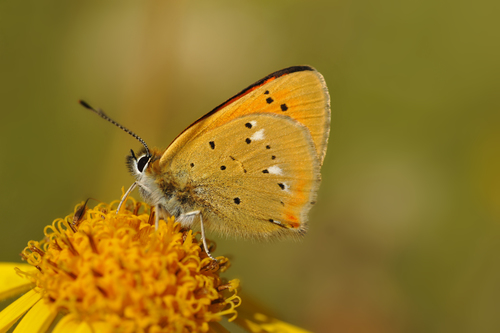
The Scarce Copper is a small to medium-sized butterfly with a wingspan of 3 to 4 cm. Sexual dimorphism is highly pronounced: males possess brilliant, unspotted, glowing coppery-red or orange upper wings with a very thin, clean black outer border. In contrast, females are less luminous, featuring golden-orange upper wings heavily patterned with rows of dark brown or black spots. The undersides of both sexes are similar, presenting a pale orange-yellow to brownish hue adorned with small black spots and a characteristic submarginal row of tiny white patches on the hindwing.
Kategorie
InsektenSeltenheit
Common
Gefahr
1/5 · Sehr gering
Snaps
Mach den ersten Snap!
Female Scarce Coppers deliberately lay their eggs near the base of withered host plants, ensuring the emerging spring larvae are close to newly sprouting sorrel leaves.
The species name 'virgaureae' refers to European Goldenrod (Solidago virgaurea), which is one of the adult butterflies' favorite nectar sources, rather than the caterpillar's host plant.
While most copper butterflies have dark spots on their upper wings, the male Scarce Copper is unique for having entirely spotless, pure orange-red upper wings.
Utilizes its highly reflective copper wings to bask in the sun at precise angles, rapidly warming up its thoracic flight muscles on cool mornings.
Males establish and fiercely guard small sunny perches, darting out to drive away rival males and other insect intruders.
Produces eggs with a thick, insulated chorion shell, allowing them to safely survive freezing winter temperatures on dry stems.
Caterpillars feed exclusively on the foliage of sorrel plants, while adult butterflies feed on the nectar of various flowering plants, especially white and yellow composites.
Altersunterschiede: Larvae chew and feed strictly on the leaves of host Rumex plants, whereas adults drink liquid nectar using a sucking proboscis.
Rumex acetosa
The primary larval host plant, providing essential nutrition to the growing caterpillars.
Cyanistes caeruleus
Preyed upon by small insectivorous birds during the adult butterfly stage.
Ichneumon suspiciosus
Larvae are occasionally parasitized by specialized parasitoid wasps.
Für dieses Objekt sind noch keine Merkmal-Badges vergeben.
Noch keine Alternativnamen vorhanden.
Sammlungen für dieses Objekt erscheinen hier, wenn weitere Themen hinzugefügt werden.
Gefahr
1/5 · Sehr gering
Noch keine besonderen Sicherheitshinweise.
Der einfachste Weg, Scarce Copper zu bestimmen, ist die Verwendung der Naturführer-App Snappit.
1+ cm
3+ cm
0.0001+ kg
1+ Jahre
12 km/h
Caterpillars feed exclusively on the foliage of sorrel plants, while adult butterflies feed on the nectar of various flowering plants, especially white and yellow composites.
Found in flower-rich dry or damp meadows, woodland clearings, and sunny hillsides, often closely associated with host sorrel plants.
Zoome hinein, um Cluster aufzulösen und zu sehen, wo dieses Objekt fotografiert wurde.
Neueste Snaps erscheinen hier, wenn neue Beobachtungen hinzukommen.



_icteritia_-_Keila.jpg&width=800)








