

Sea-Watch
angelica lucida
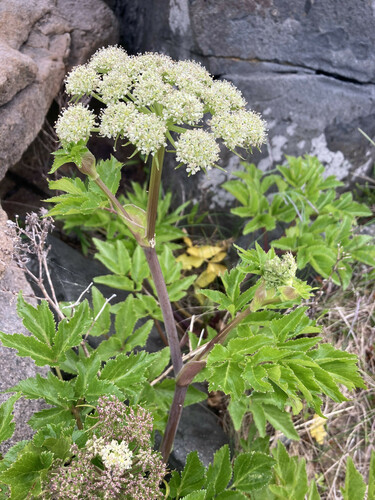
Sea-Watch (Angelica lucida), also known as seacoast angelica, is a robust and resilient perennial wildflower that thrives in the harsh, windswept environments of northern coastlines. Belonging to the carrot family (Apiaceae), this plant is beautifully adapted to withstand salty sea sprays, strong winds, and sandy, nutrient-poor soils. It serves as an essential component of coastal dune and estuary ecosystems, anchoring fragile shorelines and providing crucial food and shelter for local wildlife. Historically, various Indigenous communities prized Sea-Watch for both its edible properties and its medicinal value. Today, it stands as a striking symbol of maritime endurance, delighting coastal hikers with its bold, sculptural form and large, umbrella-like clusters of delicate white blossoms.
Lebensraum: Found on coastal dunes, gravelly beaches, rocky shorelines, salt marshes, and wet meadows near the sea.
Sea-Watch is a stout, erect herb growing between 30 and 120 centimeters tall, featuring thick, hollow, and finely ribbed stems that often take on a reddish or purplish hue near the base. Its glossy, dark green leaves are divided into broad, egg-shaped leaflets with sharply toothed margins. The most distinctive feature of this plant is its massive, dome-shaped compound umbels, which measure up to 15 centimeters across and are packed with dozens of tiny, greenish-white flowers.
Kategorie
PflanzenSeltenheit
Common
Gefahr
1/5 · Sehr gering
Snaps
Mach den ersten Snap!
Its seeds contain tiny air pockets, allowing them to float on saltwater for extended periods and colonize distant beaches.
The species name 'lucida' is Latin for 'bright' or 'shining,' which highlights the unusually glossy and lustrous surface of its leaves.
While historically used as a celery-like food by Indigenous peoples, Sea-Watch closely resembles deadly poisonous hemlocks, making wild foraging highly dangerous.
Thick, waxy leaves help the plant prevent water loss and withstand high salinity environments common along coastal shorelines.
A sturdy, thick taproot anchors the plant firmly in shifting sands and rocky crevices, securing water from deep below.
The structural design of hollow stems provides flexibility against strong coastal winds without snapping, while facilitating internal gas exchange.
As an autotrophic plant, Sea-Watch produces its own energy through photosynthesis, converting sunlight, water, and carbon dioxide into sugars.
Papilio brevicauda
Larval host plant for caterpillars.
Apis mellifera
Pollinated by insects searching for nectar.
Odocoileus virginianus
Foraged upon by large herbivores.
Für dieses Objekt sind noch keine Merkmal-Badges vergeben.
Noch keine Alternativnamen vorhanden.
Sammlungen für dieses Objekt erscheinen hier, wenn weitere Themen hinzugefügt werden.
Gefahr
1/5 · Sehr gering
Noch keine besonderen Sicherheitshinweise.
Der einfachste Weg, Sea-Watch zu bestimmen, ist die Verwendung der Naturführer-App Snappit.
30-120 cm
2-5 Jahre
As an autotrophic plant, Sea-Watch produces its own energy through photosynthesis, converting sunlight, water, and carbon dioxide into sugars.
Found on coastal dunes, gravelly beaches, rocky shorelines, salt marshes, and wet meadows near the sea.
Zoome hinein, um Cluster aufzulösen und zu sehen, wo dieses Objekt fotografiert wurde.
Neueste Snaps erscheinen hier, wenn neue Beobachtungen hinzukommen.


















