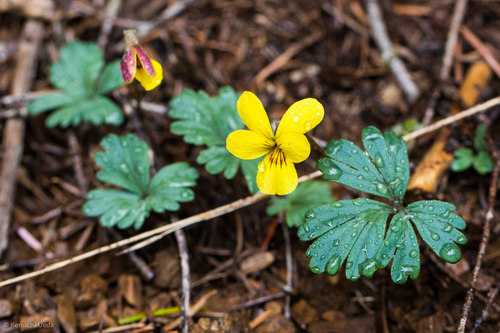


Shelton'S Violet
viola sheltonii
Shelton's Violet (Viola sheltonii) is a delightful perennial wildflower native to the Pacific Northwest of North America. This charming plant is a valuable component of the forest understory, often brightening shaded woodlands with its delicate yellow blooms in springtime. Known for its distinctive lobed leaves and unique seed dispersal mechanism, Shelton's Violet plays an important ecological role, supporting local insect populations and contributing to the biodiversity of its forest habitat. It's a true indicator of healthy, mature woodland ecosystems.
Lebensraum: Shelton's Violet is typically found in moist to dry open woodlands, forest edges, and along shaded slopes, often in coniferous or mixed conifer-hardwood forests.
Shelton's Violet is characterized by its small, vibrant yellow flowers, which often feature subtle purple-brown streaks on their lower petals, acting as nectar guides for pollinators. The flowers are typically borne singly on slender stalks, rising above the foliage. Its most distinguishing feature, however, might be its leaves: bright green, deeply palmately lobed (resembling a hand with outstretched fingers), and arising from the base of the plant. The plant typically grows to a height of 5 to 20 centimeters, forming a low clump on the forest floor.
Kategorie
PflanzenSeltenheit
Common
Gefahr
1/5 · Sehr gering
Snaps
Mach den ersten Snap!
Like many violets, Shelton's Violet can produce two distinct types of flowers: showy, insect-pollinated flowers in spring, and inconspicuous, self-pollinating cleistogamous flowers later in the growing season.
Shelton's Violet's seeds possess a fleshy appendage called an elaiosome, which attracts ants, an ecological interaction known as myrmecochory, aiding in seed dispersal.
The distinctive palmately lobed leaves of Shelton's Violet can help distinguish it from other violet species in its native habitat.
The genus Viola is remarkably diverse, encompassing over 500 species found across temperate regions worldwide, with many exhibiting unique adaptations.
This violet produces seeds equipped with a lipid-rich appendage called an elaiosome, which attracts ants. The ants carry the seeds to their nests, consume the elaiosome, and then discard the viable seed, effectively dispersing it over new ground.
In addition to its showy, insect-pollinated flowers, Shelton's Violet can produce inconspicuous, unopened flowers called cleistogamous flowers. These flowers self-pollinate, ensuring seed production even if pollinators are scarce or conditions are unfavorable for open flowering.
Adapted to its woodland environment, Shelton's Violet can thrive in the dappled light of the forest understory. Its broad, lobed leaves efficiently capture the limited sunlight filtering through the canopy.
As an autotrophic plant, Shelton's Violet produces its own food through the process of photosynthesis, converting light energy into chemical energy. It absorbs water and essential nutrients from the soil and carbon dioxide from the atmosphere.
Formica spp.
Ants carry the seeds away, dispersing them to new locations.
Odocoileus hemionus columbianus
Deer browse on the foliage of Shelton's Violet.
Boloria epithore
The larvae of this butterfly feed on the leaves of violets, including Shelton's Violet.
Für dieses Objekt sind noch keine Merkmal-Badges vergeben.
Noch keine Alternativnamen vorhanden.
Sammlungen für dieses Objekt erscheinen hier, wenn weitere Themen hinzugefügt werden.
Gefahr
1/5 · Sehr gering
Noch keine besonderen Sicherheitshinweise.
Der einfachste Weg, Shelton'S Violet zu bestimmen, ist die Verwendung der Naturführer-App Snappit.
5-20 cm
3-7 Jahre
As an autotrophic plant, Shelton's Violet produces its own food through the process of photosynthesis, converting light energy into chemical energy. It absorbs water and essential nutrients from the soil and carbon dioxide from the atmosphere.
Shelton's Violet is typically found in moist to dry open woodlands, forest edges, and along shaded slopes, often in coniferous or mixed conifer-hardwood forests.
Photosynthesis And Nutrient Absorption
Zoome hinein, um Cluster aufzulösen und zu sehen, wo dieses Objekt fotografiert wurde.
Neueste Snaps erscheinen hier, wenn neue Beobachtungen hinzukommen.

















_001.jpg&width=800)
