

Tri-Coloured Bat
perimyotis subflavus
The Tri-Colored Bat (Perimyotis subflavus), formerly known as the Eastern Pipistrelle, is a small, fascinating nocturnal mammal native to eastern North America. Renowned for its distinctive, subtly patterned fur and erratic flight, this species plays a vital ecological role as an insectivore, consuming large quantities of agricultural pests and nuisance insects. Despite its widespread historical range, the Tri-Colored Bat faces severe population declines primarily due to White-nose Syndrome, a devastating fungal disease, making it a species of significant conservation concern. Its unique hibernation patterns and foraging strategies offer a glimpse into the complex adaptations required for survival in diverse environments.
Lebensraum: Found in a variety of forested habitats, particularly deciduous and mixed forests near water bodies, and often hibernating in caves and abandoned mines.
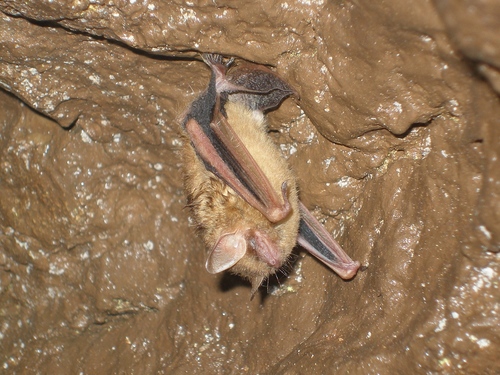
The Tri-Colored Bat is one of the smallest bat species in eastern North America, typically measuring 7-10 cm in body length. Its most distinguishing feature is its tricolored fur, which has dark bases, yellowish-tan middle sections, and brownish tips, giving it a mottled, almost frosted appearance. Its forearms and fingers are noticeably pink, contrasting with its reddish-brown flight membranes. It possesses a small, delicate snout, small ears, and a short, blunt tragus, making it visually distinct from other bat species.
Kategorie
SäugetiereSeltenheit
Common
Gefahr
1/5 · Sehr gering
Snaps
Mach den ersten Snap!
During summer, Tri-Colored Bats often roost singly or in small groups in the foliage of trees, hanging inconspicuously among leaves.
Females typically give birth to twins, a relatively rare trait among North American bat species which often have single pups.
The Tri-Colored Bat was originally known as the Eastern Pipistrelle, but recent genetic studies led to its reclassification into the genus Perimyotis.
This bat is one of the first species to emerge in the evening, sometimes even before sunset, making it a potential early spot for bat watchers.
The Tri-Colored Bat utilizes sophisticated echolocation, emitting high-frequency sounds and interpreting the echoes to construct a detailed 'sound map' of its surroundings, allowing for precise navigation and hunting in complete darkness.
During winter months, these bats undergo a prolonged period of torpor known as hibernation, dramatically lowering their metabolic rate, heart rate, and body temperature to conserve energy in cold caves and mines where food is scarce.
Known for its slow, highly erratic flight pattern, the Tri-Colored Bat is an agile aerial hunter, capable of swiftly changing direction mid-air to intercept and capture small flying insects with impressive precision.
The Tri-Colored Bat is an obligate insectivore, preying on a variety of small, soft-bodied flying insects. It plays a crucial role in controlling insect populations.
Pseudogymnoascus destructans
Fungal pathogen that causes White-nose Syndrome, a devastating disease of hibernating bats.
Megascops asio
Potential predator during active seasons, especially at night.
Culicidae (family)
Prey for the bat, important part of its diet.
Für dieses Objekt sind noch keine Merkmal-Badges vergeben.
Noch keine Alternativnamen vorhanden.
Sammlungen für dieses Objekt erscheinen hier, wenn weitere Themen hinzugefügt werden.
Gefahr
1/5 · Sehr gering
Noch keine besonderen Sicherheitshinweise.
Der einfachste Weg, Tri-Coloured Bat zu bestimmen, ist die Verwendung der Naturführer-App Snappit.
7-10 cm
21-26 cm
0.004-0.011 kg
8-15 Jahre
25 km/h
The Tri-Colored Bat is an obligate insectivore, preying on a variety of small, soft-bodied flying insects. It plays a crucial role in controlling insect populations.
Found in a variety of forested habitats, particularly deciduous and mixed forests near water bodies, and often hibernating in caves and abandoned mines.
Zoome hinein, um Cluster aufzulösen und zu sehen, wo dieses Objekt fotografiert wurde.
Neueste Snaps erscheinen hier, wenn neue Beobachtungen hinzukommen.