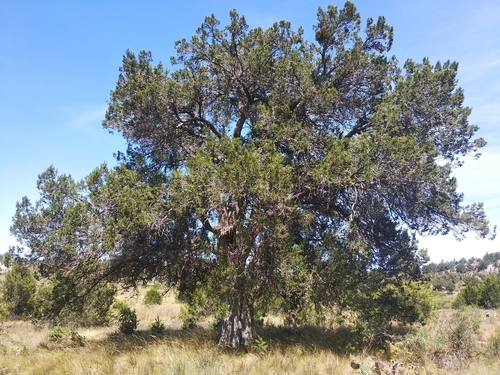


Alligator Juniper
juniperus deppeana
The Alligator Juniper is a hardy conifer native to the rugged mountainous regions of the southwestern United States and Mexico. Known for its remarkable longevity and extreme drought tolerance, this slow-growing evergreen tree serves as a cornerstone of semi-arid woodland ecosystems, offering crucial shelter and nourishment to various wildlife species. Over centuries of growth, it develops a highly unique, deeply-grooved bark that resembles alligator skin, making it one of the most charismatic trees of the American West. Its fleshy, berry-like cones are highly sought after by local fauna, ensuring its vital ecological role in high-desert communities.
Hábitat: Found in dry, rocky soils of pinyon-juniper woodlands, chaparral, and mountain slopes of the Southwestern US and Mexico, typically at elevations between 1,200 and 2,700 meters.
The Alligator Juniper is a medium-sized tree reaching up to 15 meters in height, featuring a broad, rounded crown. Its most defining characteristic is its distinctive thick, dark-gray bark which is deeply cracked into small, square plates resembling alligator leather. The foliage consists of tiny, overlapping, scale-like needles that are blue-green to glaucous-green and frequently exude a white, sticky resin. It produces spherical, berry-like seed cones about 1 to 1.5 centimeters in diameter, which start pale green and mature into a dusty, waxy blue-brown over two years.
Categoría
PlantasRareza
Common
Peligro
1/5 · Muy bajo
Snaps
¡Sé la primera persona en hacer un snap!
Its berry-like seed cones take two full years to mature, transitioning from a pale green to a deep glaucous blue-brown.
The common name Alligator Juniper comes from the bark's striking resemblance to alligator leather, featuring deeply cracked square plates.
The wood is highly rot-resistant and aromatic, historically used for fence posts and firewood, filling the desert air with a sweet, distinct scent.
Possesses an extensive deep taproot and wide lateral root system that maximizes moisture absorption from parched, rocky soils.
The thick, deeply furrowed, blocky bark protects the tree's inner cambium layer from heat, physical damage, and low-intensity wildfires.
Scale-like leaves have a thick, waxy cuticle and stomata that close during dry daylight hours to minimize water loss through transpiration.
As a photoautotrophic plant, it produces its own organic energy using sunlight, water, carbon dioxide, and soil minerals.
Myadestes townsendi
Consumes the blue-green berry-like cones and disperses the seeds across wide distances.
Phoradendron juniperinum
A hemiparasitic plant that grows on the branches of the juniper, tapping into its water and nutrient transport systems.
Dipodomys merriami
Feeds on fallen juniper seeds and caches them in underground desert burrows.
Aún no hay insignias de rasgos asignadas a este objeto.
Todavía no hay alias listados.
Las colecciones para este objeto aparecerán aquí a medida que se añadan más temas.
Peligro
1/5 · Muy bajo
Todavía no hay notas especiales de seguridad.
La forma más fácil de identificar a Alligator Juniper es usar la aplicación de identificación de naturaleza Snappit.
600-1500 cm
500-800 años
As a photoautotrophic plant, it produces its own organic energy using sunlight, water, carbon dioxide, and soil minerals.
Found in dry, rocky soils of pinyon-juniper woodlands, chaparral, and mountain slopes of the Southwestern US and Mexico, typically at elevations between 1,200 and 2,700 meters.
Acércate para separar los grupos y explorar dónde se ha fotografiado este objeto.
Los snaps recientes aparecerán aquí a medida que se añadan nuevas observaciones.