American Gizzard Shad
dorosoma cepedianum
The American Gizzard Shad is a shiny fish that loves to swim in schools. It has a special gizzard that helps it eat tiny plants and animals in the water!
Hábitat: Lakes, rivers, and reservoirs across North America
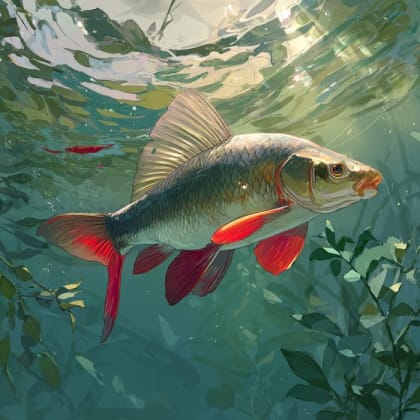
The American Gizzard Shad has a distinctive deep, silvery body, often with a slightly darker blue-green back. Its most notable feature is a very long, whip-like ray extending from the dorsal fin. They also possess a small head and a blunt snout.
Categoría
PecesRareza
Common
Peligro
0/5 · Sin peligro conocido
Snaps
¡Sé la primera persona en hacer un snap!
Their long dorsal fin ray can be longer than their whole head!
They are named for their gizzard-like stomach, just like a chicken!
They play a super important role, turning tiny particles into food for bigger fish!
Thousands of Gizzard Shad often swim together in huge, shimmering schools!
American Gizzard Shad has a muscular gizzard stomach, similar to birds, that helps them grind tough plant material.
American Gizzard Shad can filter-feed using special gill rakers, allowing them to eat microscopic plankton from water.
American Gizzard Shad can survive in murkier, less oxygenated, and even slightly polluted waters that many other fish avoid.
They are filter-feeders, scooping up tiny plants and decaying bits from the water.
Diferencias por edad: Younger shad primarily eat zooplankton, while adults shift to consuming more phytoplankton and detritus.
Micropterus salmoides
A primary food source for this popular game fish.
Morone saxatilis
An essential prey item in brackish and freshwater systems.
Pandion haliaetus
Often preyed upon by these skilled fish-eating raptors.
Los animales sociales viven en grupos organizados, cooperando para obtener beneficios de supervivencia como la búsqueda de alimento, la defensa y la cría de descendencia.
Los filtradores obtienen nutrientes filtrando partículas de alimentos suspendidos y pequeños organismos del agua.
Este rasgo identifica a los organismos cuya dieta consiste total o principalmente en tejido animal.
Los hábitats acuáticos abarcan entornos donde los organismos viven principalmente en el agua, incluidos océanos, ríos, lagos y humedales.
Peligro
0/5 · Sin peligro conocido
Todavía no hay notas especiales de seguridad.
20-40 cm
0.2-1 kg
5-10 años
They are filter-feeders, scooping up tiny plants and decaying bits from the water.
20 km/h
Lakes, rivers, and reservoirs across North America
Filter Feeding
20 m
Acércate para separar los grupos y explorar dónde se ha fotografiado este objeto.
Los snaps recientes aparecerán aquí a medida que se añadan nuevas observaciones.