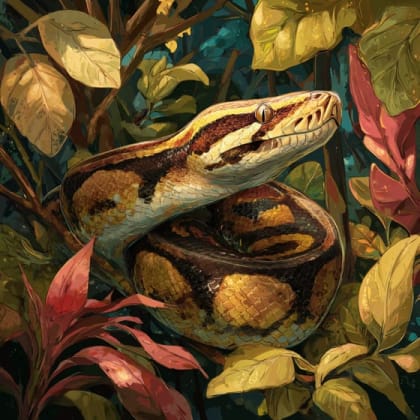




Banded Watersnake
Nerodia fasciata
The Banded Watersnake is a friendly snake that loves to swim in water! It has beautiful stripes that help it blend in with its surroundings, making it a great swimmer and a fun creature to spot.
Hábitat: Wetlands
The Banded Watersnake has a thick body with distinct dark crossbands (brown, reddish-brown, or black) on a lighter background (tan, gray, or yellow). Its bands are usually wider in the middle of its back. It also has a dark stripe running from its eye to the corner of its jaw.
Categoría
ReptilesRareza
Common
Peligro
2/5 · Bajo
Snaps
¡Sé la primera persona en hacer un snap!
Female watersnakes can have up to 50 live babies at once! Wow!
Many people mistake them for venomous cottonmouths, but they are harmless!
They're like submarine hunters, catching fish underwater!
When scared, they might release a smelly musk to warn you off.
Banded Watersnake can hunt for fish and frogs underwater because it is an excellent swimmer and can hold its breath for extended periods.
Banded Watersnake has patterned crossbands that help them blend into the muddy, reedy banks and mucky water of their habitat, hiding from predators and prey.
Banded Watersnake can give birth to live baby snakes, called neonates, which are ready to swim and hunt on their own right away.
Banded Watersnake can flatten its body and head when threatened, making itself look larger and more intimidating to scare away potential attackers.
These aquatic snakes are expert hunters, mainly eating fish, frogs, and salamanders from freshwater habitats.
Diferencias por edad: Young snakes eat smaller versions of adult prey, such as small fish and tadpoles.

Gambusia holbrooki
A common food source in southern waterways.
%2C_Vorderansich.jpg&width=800)
Lithobates sphenocephalus
Often ambushed near the water's edge or caught swimming.
Alligator mississippiensis
Large alligators are predators of juvenile and adult watersnakes.
Procyon lotor
Predates on watersnakes encountered near water bodies.
Marcado con bandas paralelas o líneas de color.
Los animales solitarios viven solos durante la mayor parte de su vida y solo interactúan con otros para aparearse o cuidar de sus crías.
El camuflaje describe a los organismos que poseen colores o patrones que les permiten mezclarse con su entorno.
Los organismos piscívoros son animales que subsisten principalmente de una dieta a base de peces.

Este rasgo de hábitat identifica especies que se encuentran en humedales, que son áreas de tierra saturadas de agua, ya sea permanente o estacionalmente, e incluyen marismas, pantanos y ciénagas.

Este rasgo identifica a los organismos cuya dieta consiste total o principalmente en tejido animal.

Los animales diurnos están activos principalmente durante el día y suelen descansar o dormir por la noche.

Los hábitats acuáticos abarcan entornos donde los organismos viven principalmente en el agua, incluidos océanos, ríos, lagos y humedales.
Todavía no hay alias listados.
Peligro
2/5 · Bajo
If you see a snake, it's best to watch it from a distance and not touch it.
60-150 cm
0.2-2 kg
5-10 años
3 km/h
These aquatic snakes are expert hunters, mainly eating fish, frogs, and salamanders from freshwater habitats.
5 km/h
Wetlands
Pursuit
Acércate para separar los grupos y explorar dónde se ha fotografiado este objeto.
Los snaps recientes aparecerán aquí a medida que se añadan nuevas observaciones.