


blackjack oak
Quercus marilandica
The blackjack oak is a sturdy tree that grows in dry, sandy areas. Its leaves are unique and can turn beautiful colors in the fall, making it a lovely sight in nature!
Hábitat: Forests
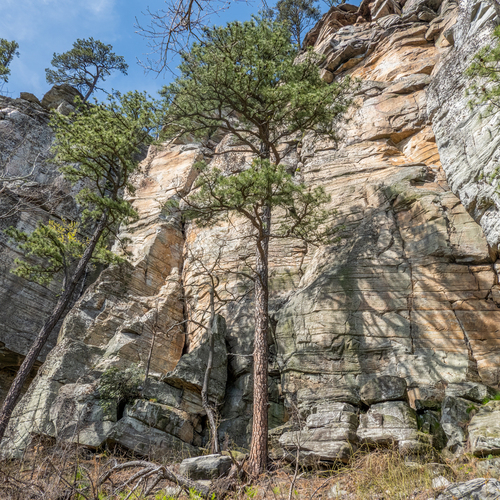
The blackjack oak has distinctive dark, blocky bark and stiff, leathery leaves that are often wider towards the tip with three shallow lobes, giving them a duck-foot shape. Its overall form is often irregular and scraggly, sometimes with reddish-brown fall foliage.
Categoría
PlantasRareza
Common
Peligro
1/5 · Muy bajo
Snaps
¡Sé la primera persona en hacer un snap!
Did you know its strong wood was once used to make fence posts and charcoal?
Some people call its uniquely shaped leaves 'duck-foot' leaves because of their wide, three-lobed tip!
The acorns of the blackjack oak have a fuzzy cap that covers more than half of the nut!
This hardy tree can often be found growing in poor, dry soils where other trees struggle to survive.
Blackjack oak has a deep taproot that helps it reach groundwater, allowing it to survive long dry spells and poor soils.
Its incredibly thick, dark bark protects the blackjack oak from damage during ground fires that sweep through its habitat.
Blackjack oak has tough, leathery leaves that are designed to reduce water loss, helping it thrive in intense sun.
Sciurus carolinensis
eats blackjack oak acorns
Odocoileus virginianus
browses leaves and eats acorns
Satyrium calanus
larvae feed on oak leaves
Amanita muscaria
mycorrhizal fungi partner
Las plantas caducifolias pierden periódicamente todas sus hojas, por lo general durante el otoño o las estaciones secas.
Las plantas que producen nueces dan frutos de cáscara dura, comúnmente conocidos como frutos secos o nueces, que contienen una sola semilla y son una valiosa fuente de alimento.
Los árboles de hoja ancha son angiospermas caracterizadas por hojas planas y anchas que típicamente se caen anualmente en climas templados.
Las plantas tolerantes a la sequía pueden sobrevivir y florecer en condiciones de escasa disponibilidad de agua.

Los colores otoñales se refieren al cambio estacional en la pigmentación del follaje, principalmente en plantas de hoja caduca, mostrando tonos vibrantes.

Se refiere a la madera que ha sido preparada para su uso en la construcción y la carpintería.

Los hábitats boscosos son entornos terrestres dominados por una densa cubierta arbórea, que sustentan una gran diversidad de vida animal y vegetal.

Este rasgo caracteriza a los organismos con una esperanza de vida excepcionalmente larga en comparación con otros de su especie.
Todavía no hay alias listados.
Peligro
1/5 · Muy bajo
Stay away from the tree's sharp acorns, but enjoy looking at its beautiful leaves!
500-1500 cm
400-1000 cm
Primavera
No
Leve
Perenne
Viento
Forests
Acércate para separar los grupos y explorar dónde se ha fotografiado este objeto.
Los snaps recientes aparecerán aquí a medida que se añadan nuevas observaciones.