

Blewit
collybia nuda
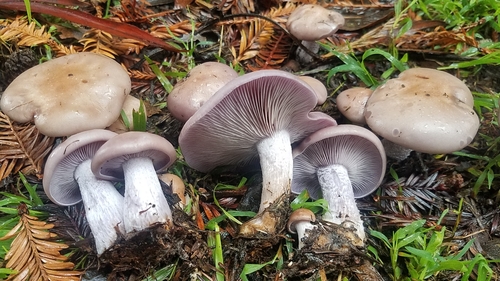
The Blewit, recorded under the names Collybia nuda, Lepista nuda, or Clitocybe nuda, is a striking and highly sought-after woodland mushroom. Renowned for its beautiful purplish hues and sweet, floral aroma that some liken to frozen orange juice, this fungus is a favorite among autumn foragers. Blewits are saprotrophic organisms, meaning they derive their nutrients by breaking down dead and decaying organic matter. By digesting tough lignin and cellulose in leaf litter, they play an essential role in recycling nutrients back into the forest ecosystem. They are especially famous for their tendency to fruit late in the season, often persisting through the first mild frosts of winter. Aside from their ecological importance, they are celebrated for their culinary value, offering a rich, earthy flavor once properly cooked. Whether found forming mysterious 'fairy rings' in a dark forest or sprouting from a suburban compost heap, the Blewit remains one of the most charismatic and beneficial macrofungi of the cooler months.
Hábitat: Found in dense deciduous and coniferous forests, often growing abundantly on decaying leaf litter, pine needles, or nutrient-rich compost heaps.
Blewits are easily recognized when young by their vivid lilac or bluish-purple caps, stems, and gills. The cap, which ranges from 4 to 15 centimeters in diameter, starts out convex with noticeably inrolled margins, but gradually flattens and becomes wavy or irregular as it matures. Over time, the vibrant purple color tends to fade from the center outward, shifting to a tan, brownish, or pinkish-buff shade, though the crowded gills usually retain their lilac tint much longer. The stem is stout, solid, and typically features a slightly bulbous base coated in fuzzy purple mycelium. A key identifier is the spore print, which is a pale pinkish-buff, helping to distinguish it from dangerous purple lookalikes like the Cortinarius species that have rusty brown spores.
Categoría
HongosRareza
Common
Peligro
1/5 · Muy bajo
Snaps
¡Sé la primera persona en hacer un snap!
Although edible and delicious, blewits must be thoroughly cooked before eating, as they contain volatile toxins that can cause gastric upset if consumed raw.
Blewits have a distinct, slightly sweet scent that many foragers compare to frozen orange juice or anise.
Their vibrant purple color is thought to act as a natural camouflage against the dark, purplish hues of decomposing autumn leaves in a shadowed forest.
They are famous for growing in large circles called 'fairy rings,' which can expand outward each year and persist for decades.
Excretes powerful extracellular enzymes that break down complex organic compounds like lignin and cellulose in dead leaves.
Possesses a remarkable resilience to cold temperatures, allowing the fruiting bodies to survive and grow during late autumn frosts.
Forms massive underground networks that radiate outward, often resulting in large circular fruiting formations known as fairy rings.
As a saprotrophic fungus, it feeds by breaking down dead plant material and absorbing the resulting nutrients.
Quercus robur
Provides the fallen leaf litter that the fungus breaks down for its primary food source.
Sciara thomae
Lays eggs in the mushroom, and the resulting larvae feed heavily on the fungal tissue.
Sciurus carolinensis
Forages on the fleshy caps of the mushrooms during the autumn months to stockpile calories.
Aún no hay insignias de rasgos asignadas a este objeto.
Todavía no hay alias listados.
Las colecciones para este objeto aparecerán aquí a medida que se añadan más temas.
Peligro
1/5 · Muy bajo
Todavía no hay notas especiales de seguridad.
La forma más fácil de identificar a Blewit es usar la aplicación de identificación de naturaleza Snappit.
4-15 cm
0.01-0.15 kg
1-20 años
As a saprotrophic fungus, it feeds by breaking down dead plant material and absorbing the resulting nutrients.
Found in dense deciduous and coniferous forests, often growing abundantly on decaying leaf litter, pine needles, or nutrient-rich compost heaps.
Foraging
Acércate para separar los grupos y explorar dónde se ha fotografiado este objeto.
Los snaps recientes aparecerán aquí a medida que se añadan nuevas observaciones.