

Blue Cohoshes
caulophyllum
Blue Cohosh (Caulophyllum thalictroides) is a fascinating perennial herb native to rich deciduous forests of eastern North America. Renowned for its unique blue berries and early spring blooms, this plant holds significant historical and contemporary importance, particularly in traditional herbal medicine. Its striking appearance, with purplish-green foliage and later, a vibrant blue fruit, makes it a distinctive member of the woodland understory. While visually appealing, it also plays a crucial ecological role in its native habitat.
Hábitat: Found primarily in rich, moist deciduous forests, often in areas with deep, fertile soil, and thrives in partial to full shade under a canopy of broadleaf trees.
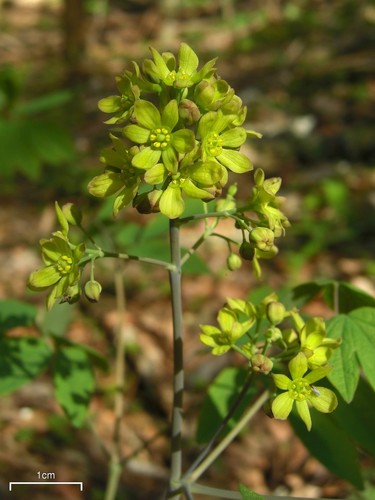
Blue Cohosh is characterized by its smooth, purplish-green stems that emerge in early spring, branching near the top to support large, deeply lobed, ternate (divided into three) leaves. The foliage can appear somewhat blue-green. Small, yellowish-green to purplish-brown flowers emerge in clusters above the leaves in early spring. The most distinctive feature is its pea-sized, bright blue, waxy berries that resemble small grapes, appearing in late summer and persisting into fall after the foliage has matured or withered.
Categoría
PlantasRareza
Common
Peligro
1/5 · Muy bajo
Snaps
¡Sé la primera persona en hacer un snap!
Blue Cohosh is sometimes called 'Papoose Root' or 'Squaw Root' due to its traditional use by Native American women.
Despite its common name, Blue Cohosh is not closely related to 'Black Cohosh' (Actaea racemosa), though both are used in herbal medicine.
The blue 'berries' are actually naked seeds encased in a fleshy, waxy coating, and are considered toxic to humans if ingested due to saponins.
The plant's scientific name, 'Caulophyllum,' means 'stem leaf,' referring to how its leaves appear to grow directly from the stem.
Historically, Native American tribes and later European settlers used Blue Cohosh for various medicinal purposes, particularly in childbirth and for gynecological issues due to its uterine stimulant properties.
Unlike typical berries, the 'berries' of Blue Cohosh are actually naked seeds covered in a fleshy, bright blue aril, making them highly attractive to birds for seed dispersal.
It is one of the earliest plants to emerge in the spring, leveraging the period before the forest canopy fully leafs out to capture sunlight and complete much of its growth cycle.
As a photosynthetic plant, Blue Cohosh produces its own food using sunlight, water, and carbon dioxide. It absorbs essential nutrients from the soil through its root system.
Bombus spp.
Pollinates flowers during spring bloom.
Turdus migratorius
Consumes the blue berries, aiding in seed dispersal through its droppings.
Odocoileus virginianus
May browse on foliage, especially young shoots, but generally not a primary food source.

Trillium spp.
Shares similar habitat requirements and competes for resources like light and nutrients.
Aún no hay insignias de rasgos asignadas a este objeto.
Todavía no hay alias listados.
Las colecciones para este objeto aparecerán aquí a medida que se añadan más temas.
Peligro
1/5 · Muy bajo
Todavía no hay notas especiales de seguridad.
La forma más fácil de identificar a Blue Cohoshes es usar la aplicación de identificación de naturaleza Snappit.
30-90 cm
0.05-0.2 kg
5-20 años
As a photosynthetic plant, Blue Cohosh produces its own food using sunlight, water, and carbon dioxide. It absorbs essential nutrients from the soil through its root system.
Found primarily in rich, moist deciduous forests, often in areas with deep, fertile soil, and thrives in partial to full shade under a canopy of broadleaf trees.
Absorption
2-6
Acércate para separar los grupos y explorar dónde se ha fotografiado este objeto.
Los snaps recientes aparecerán aquí a medida que se añadan nuevas observaciones.












