

Bluntnose Minnow
pimephales notatus
The Bluntnose Minnow (Pimephales notatus) is one of the most abundant and ecologically vital freshwater fish species in North America. Often overlooked due to its small size and unassuming appearance, this hardy minnow plays a key role in aquatic ecosystems as a primary food source for many popular sport fish. Known for its adaptability, it thrives in a wide range of freshwater environments, from clear, fast-flowing gravel streams to turbid lakes and reservoirs. During the breeding season, males undergo a dramatic transformation, developing dark pigmentation and specialized horn-like tubercles on their snouts, which they use to defend nesting sites under stones or debris. They are incredibly resilient, tolerant of various water qualities, and have a unique social structure that makes them a fascinating subject for freshwater observers and biologists alike.
Hábitat: Found in a wide variety of freshwater environments, including gravel-bottomed creeks, small streams, rocky lakes, and slow-moving rivers across eastern and central North America.
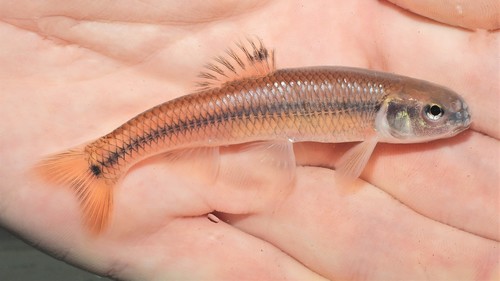
The Bluntnose Minnow is a small, slender fish, typically ranging from 5 to 11 centimeters in length. It is easily identified by its notably blunt, rounded snout and a slightly compressed, cylindrical body with a flat back. Its coloration is generally olivaceous to pale silver-green on the back, fading to a silvery-white belly. A distinct, dark lateral stripe runs from the tip of the snout, through the eye, all the way to the base of the tail fin, where it terminates in a prominent dark spot. Additionally, the scales on its back are small and crowded, giving it a somewhat cross-hatched or dark-edged appearance.
Categoría
PecesRareza
Common
Peligro
1/5 · Muy bajo
Snaps
¡Sé la primera persona en hacer un snap!
During breeding season, males develop a dark 'breeding mask' and three rows of horn-like tubercles on their snouts to fight rivals and scrape algae off nesting surfaces.
Male Bluntnose Minnows are dedicated fathers; they guard the eggs under stones, aggressively driving away predators and fanning the eggs with their fins to keep them oxygenated and clean.
They possess an extraordinary sense of smell and rely on chemical alarm signals released from damaged skin cells to warn their school of nearby predators.
When injured, the Bluntnose Minnow releases a chemical alarm signal called 'Schreckstoff' from its skin to warn nearby schoolmates of predators.
During breeding, males grow tough, horn-like snout tubercles used to aggressively defend nesting cavities and clean potential egg sites.
Unlike many sensitive minnows, this species has high tolerance for muddy water, allowing it to thrive and forage in degraded aquatic habitats.
They are opportunistic bottom-feeders that consume a mixture of organic detritus, small aquatic insects, microcrustaceans, and algae.
Micropterus dolomieu
The Bluntnose Minnow serves as a critical food source for adult Smallmouth Bass in rocky river habitats.
Micropterus salmoides
Often hunted by Largemouth Bass in slow-moving waters and shallow lake margins.
Chironomidae
Bluntnose Minnows feed heavily on midge larvae found in the muddy substrate of streams and rivers.
Aún no hay insignias de rasgos asignadas a este objeto.
Todavía no hay alias listados.
Las colecciones para este objeto aparecerán aquí a medida que se añadan más temas.
Peligro
1/5 · Muy bajo
Todavía no hay notas especiales de seguridad.
La forma más fácil de identificar a Bluntnose Minnow es usar la aplicación de identificación de naturaleza Snappit.
5+ cm
0.002+ kg
2+ años
8 km/h
They are opportunistic bottom-feeders that consume a mixture of organic detritus, small aquatic insects, microcrustaceans, and algae.
Found in a wide variety of freshwater environments, including gravel-bottomed creeks, small streams, rocky lakes, and slow-moving rivers across eastern and central North America.
Foraging
Acércate para separar los grupos y explorar dónde se ha fotografiado este objeto.
Los snaps recientes aparecerán aquí a medida que se añadan nuevas observaciones.