

California Fetid Adderstongue
scoliopus bigelovii
The California Fetid Adderstongue is an extraordinary and enigmatic wildflower native to the damp, deeply shaded redwood forests of Northern California. Emerging during the wet, chilly months of winter and early spring, this small perennial heralds the changing seasons long before most other forest plants begin to wake. Its unique name stems from the pungent, mushroom-like aroma emitted by its flowers, which mimics the scent of decaying matter to attract its primary pollinators, fungus gnats. Beyond its intriguing scent, this plant is characterized by its pair of beautifully mottled green leaves that hug the forest floor, framing delicate, intricately patterned flowers. Observing this botanical gem in its natural habitat offers a fascinating glimpse into the complex evolutionary strategies of forest floor understory plants.
Hábitat: Found in deep shade on the damp, moist floors of coastal redwood and Douglas fir forests, often near streams or in dense leaf litter.
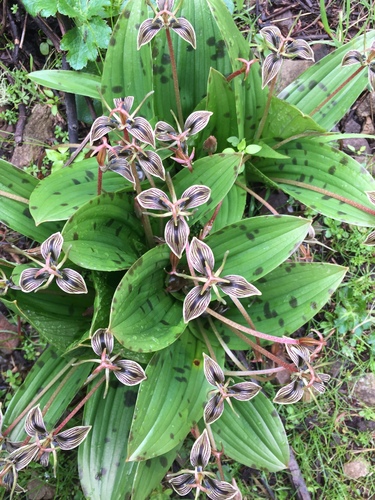
This low-growing perennial features a single pair of broad, oval-shaped leaves, measuring 10 to 20 centimeters in length, which are bright green and prominently mottled with dark purple or brown spots. From the center of these leaves arise several slender, curving flower stalks, each bearing a single small blossom. The flowers have three narrow, spreading sepals striped with rich brownish-purple, contrasting with three tiny, needle-like petals that curve over the reproductive organs, giving the entire bloom an elegant, spider-like appearance.
Categoría
PlantasRareza
Common
Peligro
1/5 · Muy bajo
Snaps
¡Sé la primera persona en hacer un snap!
Its seeds have a fleshy, nutrient-rich appendage called an elaiosome, which acts as a delicious reward for ants that carry the seeds away to plant them.
The common name 'fetid adderstongue' comes from the flower's unpleasant mushroom-like or rotten smell, which mimics decaying matter.
This species is among the absolute earliest wildflowers to bloom in Northern California, often opening its flowers in January when temperatures are near freezing.
The flowers release a pungent, musty scent resembling rotting fungi or organic matter to lure in unsuspecting fungus gnats.
The seeds feature nutrient-rich structures called elaiosomes that entice ants to carry them back to their nests, dispersing the plant.
Its early flowering cycle allows it to bloom between January and March, capturing sunlight and pollinator attention before the forest canopy closes.
As a photoautotrophic plant, it produces its own energy through photosynthesis, utilizing sunlight, carbon dioxide, and soil nutrients.
Mycetophila fungorum
Pollinated by adult fungus gnats attracted by the flower's fetid smell.
Formica obscuripes
Ants collect the seeds for their lipid-rich elaiosomes, dispersing them to new locations.
Sequoia sempervirens
Grows in the deep shade and moist, acidic leaf litter provided by Coast Redwood trees.
Aún no hay insignias de rasgos asignadas a este objeto.
Todavía no hay alias listados.
Las colecciones para este objeto aparecerán aquí a medida que se añadan más temas.
Peligro
1/5 · Muy bajo
Todavía no hay notas especiales de seguridad.
La forma más fácil de identificar a California Fetid Adderstongue es usar la aplicación de identificación de naturaleza Snappit.
5-25 cm
0.01-0.05 kg
5-20 años
As a photoautotrophic plant, it produces its own energy through photosynthesis, utilizing sunlight, carbon dioxide, and soil nutrients.
Found in deep shade on the damp, moist floors of coastal redwood and Douglas fir forests, often near streams or in dense leaf litter.
10-35
60-120 días
Acércate para separar los grupos y explorar dónde se ha fotografiado este objeto.
Los snaps recientes aparecerán aquí a medida que se añadan nuevas observaciones.

California, US
Puedes ver Redwood Sorrel, Secuoya y Button's Banana Slug.
Ver guía →

California, US
Puedes ver Hilton's Aeolid y Opalescent Nudibranch.
Ver guía →

California, US
Puedes ver Pacific Banana Slug y Trillium Del Pacífico.
Ver guía →