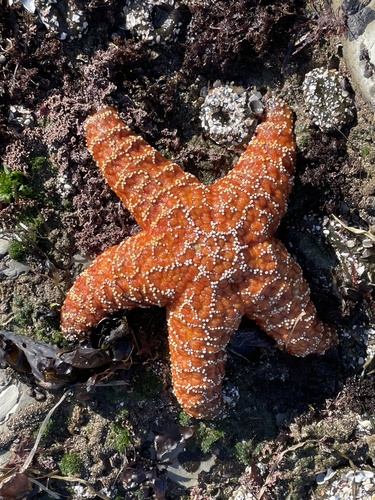
Chain Tunicate
botrylloides violaceus
The Chain Tunicate is a fascinating sea creature that looks like a colorful blob! It can form large colonies, making it a fun sight to see in the ocean.
Hábitat: Chain Tunicates live in marine environments, often attached to rocks and other surfaces in shallow waters.
The Chain Tunicate is a small, colonial invertebrate forming thin, sheet-like encrustations on surfaces. It often displays vibrant colors like purple, orange, or green, with individual zooids arranged in star or chain-like patterns connected by a common vascular system.
Categoría
InvertebrateRareza
Common
Peligro
0/5 · Sin peligro conocido
Snaps
¡Sé la primera persona en hacer un snap!
A single Chain Tunicate colony can contain thousands of tiny individual animals!
Chain Tunicates have no brain or heart, yet they thrive in the ocean!
These creatures can amazingly filter gallons of water every single day!
They are invasive species, spreading rapidly across new ocean territories!
Chain Tunicate can heal damaged parts of its colony because of amazing regenerative cells that help them survive injuries.
Chain Tunicate can reproduce both sexually and asexually by budding, which helps them spread rapidly and colonize new areas.
Chain Tunicate has a strong adhesive property that helps them securely attach to various underwater surfaces, even smooth ones.
These ocean critters feast on tiny floating particles by filtering seawater through their bodies.
Triopha catalinae
This sea slug sometimes grazes on tunicate colonies as a food source.
Carcinus maenas
These invasive crabs are known to consume tunicates from various surfaces.
Tautogolabrus adspersus
This small fish forages on rocky substrates, sometimes consuming tunicates.
Los animales sociales viven en grupos organizados, cooperando para obtener beneficios de supervivencia como la búsqueda de alimento, la defensa y la cría de descendencia.
Colorido describe a organismos u objetos que exhiben una amplia variedad de colores brillantes y distintivos.
Los filtradores obtienen nutrientes filtrando partículas de alimentos suspendidos y pequeños organismos del agua.
Los hábitats acuáticos abarcan entornos donde los organismos viven principalmente en el agua, incluidos océanos, ríos, lagos y humedales.

Los hábitats marinos abarcan todos los entornos de agua salada de los océanos de la Tierra, sustentando una inmensa diversidad de vida acuática.
Peligro
0/5 · Sin peligro conocido
Todavía no hay notas especiales de seguridad.
2 años
These ocean critters feast on tiny floating particles by filtering seawater through their bodies.
Chain Tunicates live in marine environments, often attached to rocks and other surfaces in shallow waters.
Filter Feeding
10 m
15 cm
3 mm
Acércate para separar los grupos y explorar dónde se ha fotografiado este objeto.
Los snaps recientes aparecerán aquí a medida que se añadan nuevas observaciones.