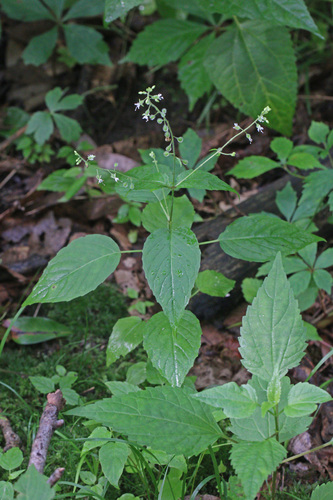
False Nettle
boehmeria cylindrica
False Nettle is a tall, green plant that likes to grow near rivers and in wet areas. Its leaves are soft and fuzzy, making it a comfy home for little critters!
Hábitat: False Nettle typically grows in moist soil near rivers, streams, and wetlands.
The False Nettle has rough, deep green leaves with toothed edges, resembling stinging nettles but lacking their painful sting. Its slender, often reddish stems bear tiny, greenish-white flowers clustered in spikes, making them quite inconspicuous.
Categoría
PlantasRareza
Common
Peligro
0/5 · Sin peligro conocido
Snaps
¡Sé la primera persona en hacer un snap!
Ancient cultures used its strong stem fibers for weaving cloth and rope!
Despite its name, you can safely touch this plant; it won't sting you!
Find it lurking in shady, damp spots, especially along forest edges!
Its tiny leaves are surprisingly edible when cooked, like spinach!
False Nettle has soft, harmless hairs on its leaves, making it a convincing lookalike for stinging nettles without the painful sting.
False Nettle can thrive in shady, damp environments, allowing it to grow where many other plants struggle to find light.
False Nettle possesses tough stem fibers, historically used by people to weave strong ropes and durable fabrics.
Polygonia interrogationis
Caterpillars feed on its leaves.
Odocoileus virginianus
Deer browse on its foliage.
Apis mellifera
Bees visit its small flowers for nectar.
Vanessa atalanta
Caterpillars also consume its leaves.
Los animales sociales viven en grupos organizados, cooperando para obtener beneficios de supervivencia como la búsqueda de alimento, la defensa y la cría de descendencia.
Colorido describe a organismos u objetos que exhiben una amplia variedad de colores brillantes y distintivos.
Este rasgo caracteriza a los organismos cuya dieta consiste total o principalmente en material vegetal.
Los hábitats boscosos son entornos terrestres dominados por una densa cubierta arbórea, que sustentan una gran diversidad de vida animal y vegetal.

Los hábitats acuáticos abarcan entornos donde los organismos viven principalmente en el agua, incluidos océanos, ríos, lagos y humedales.
Peligro
0/5 · Sin peligro conocido
Todavía no hay notas especiales de seguridad.
30-120 cm
30-60 cm
0.1-0.3 cm
Late summer to early fall
Sí
Ninguna
Perenne
Insectos
Acércate para separar los grupos y explorar dónde se ha fotografiado este objeto.
Los snaps recientes aparecerán aquí a medida que se añadan nuevas observaciones.