.jpg&width=800)





field bindweed
Convolvulus arvensis
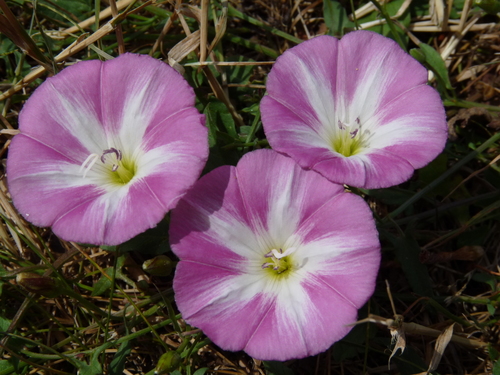
Field bindweed is a climbing plant with pretty white or pink flowers. It loves to twine around other plants and can grow in many places, making it a familiar sight in fields and gardens.
Hábitat: Grasslands
The field bindweed has slender, twining stems and arrow-shaped green leaves. Its small, funnel-shaped flowers are typically white or pale pink, often with five faint stripes. It can be visually distinguished by its creeping, mat-forming growth.
Categoría
PlantasRareza
Common
Peligro
1/5 · Muy bajo
Snaps
¡Sé la primera persona en hacer un snap!
A single field bindweed plant can produce hundreds of seeds in just one season!
It's a "morning glory" relative, with flowers that typically close by afternoon!
Its incredibly deep roots can stretch more than two meters underground!
The delicate bell-shaped flowers of bindweed only stay open for a single day!
Field bindweed can send roots over two meters deep to find water and nutrients, helping it survive drought.
Field bindweed has flexible stems that coil around other plants to climb, reaching sunlight above its competitors.
Field bindweed seeds can remain dormant in the soil for decades, allowing new plants to emerge over many years.
Apis mellifera
Collects nectar and pollen from flowers.
Galeruca rufa
Larvae and adults feed on bindweed leaves.
Crocidosema plebejana
Larvae tunnel into stems and roots.
Las plantas trepadoras o enredaderas se caracterizan por un hábito de crecimiento que les permite ascender enrollándose o usando zarcillos o raíces adhesivas.
Las plantas con flores son cualquier planta que produce flores como parte de su ciclo reproductivo.
Las plantas de floración de verano producen sus flores durante la temporada estival, a menudo aportando un color vibrante cuando muchas otras plantas ya han terminado de florecer.
Las plantas de crecimiento rápido exhiben tasas de crecimiento aceleradas, aumentando rápidamente de tamaño y biomasa en un corto período de tiempo.

Describe plantas que son particularmente atractivas y beneficiosas para una amplia variedad de organismos polinizadores.

Los hábitats de pastizales son biomas terrestres dominados por pastos y plantas herbáceas, que sustentan a una variedad de animales de pastoreo.

Las especies invasoras son organismos no nativos que causan daños al medio ambiente, la economía o la salud humana.
Todavía no hay alias listados.
Peligro
1/5 · Muy bajo
While field bindweed is not harmful, it's best to look and not touch wild plants without asking an adult.
10-100 cm
100-300 cm
1.5-2.5 cm
Verano
No
Leve
Perenne
Insectos
Acércate para separar los grupos y explorar dónde se ha fotografiado este objeto.
Los snaps recientes aparecerán aquí a medida que se añadan nuevas observaciones.

Massachusetts, US
Puedes ver European Flat Oyster, Staghorn Sumac y Bird's-Foot Trefoil.
Ver guía →
California, US
Puedes ver Field Bindweed, Charlock y Figeater Beetle.
Ver guía →
.jpg)
Washington, US
Puedes ver Cuervo Americano, Redstem Stork's-Bill y Junco Ojioscuro.
Ver guía →

California, US
Puedes ver Valley Oak, Two-Horned Gall Wasp y árbol De La Seda.
Ver guía →
California, US
Puedes ver Field Bindweed, White Clover y Lesser Goldfinch.
Ver guía →