

Four-Leaved Milkweed
asclepias quadrifolia
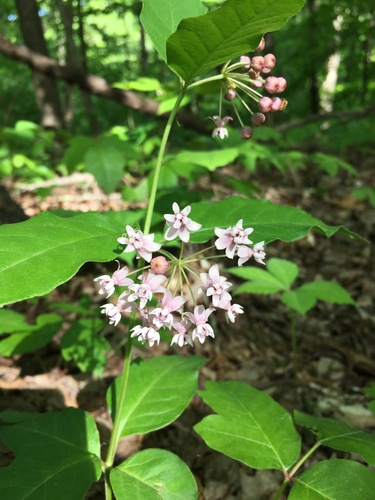
The Four-Leaved Milkweed (Asclepias quadrifolia) is a delicate, shade-tolerant perennial wildflower native to the eastern United States. Unlike its sun-loving cousins that dominate open fields and roadsides, this subtle beauty thrives in the dappled light of rocky, upland forests and woodland edges. It gets its name from the distinctive arrangement of its leaves, which typically feature a prominent central whorl of four leaves. In late spring to early summer, it produces small, elegant clusters of pale pink to white crown-like flowers. These blossoms offer a vital nectar source for a variety of woodland pollinators, from native bees to early butterflies. Despite its delicate appearance, this plant is remarkably resilient, possessing the characteristic milky sap of the milkweed family, which deters generalist herbivores with toxic cardenolides. Observing this quiet woodland plant offers a rewarding glimpse into the complex, often hidden biodiversity of Eastern North American forests.
Hábitat: Found in dry to moist upland deciduous forests, rocky woodlands, and shaded slopes across eastern North America.
This slender perennial typically stands between 20 to 50 cm tall. It features opposite, lance-shaped to ovate leaves, with a characteristic central node bearing a whorl of four leaves, while other nodes usually contain only pairs. The leaves are relatively thin, smooth, and light green. Its blossoms are arranged in loose, nodding, umbrella-like clusters (umbels) at the top of the stem or from the upper leaf axils. Each flower is small (about 6 mm across) with five reflexed, pale pink to white petals surrounding a raised central crown. After pollination, it develops narrow, upright seed pods (follicles) that dry and split open to release silky-tufted seeds.
Categoría
PlantasRareza
Common
Peligro
1/5 · Muy bajo
Snaps
¡Sé la primera persona en hacer un snap!
Although it is a host plant for Monarch butterfly larvae, Monarchs rarely use it because they prefer sunnier habitats, making it a safe haven for other woodland specialists.
Its scientific name, Asclepias, honors Asklepios, the Greek god of medicine, because of the historical medicinal uses of various milkweed species.
Unlike most common milkweeds that require open, sunny fields, the Four-Leaved Milkweed is a true forest dweller, adapted to deep woodland shade.
The plant produces a sticky, white latex sap containing cardiac glycosides (cardenolides) that are toxic to most mammalian and insect herbivores.
Unlike most other milkweed species that require full sun, it has adapted to photosynthesize efficiently in the filtered, low-light conditions of forest understories.
The seeds are attached to fine, silky hairs (coma) that catch the slightest forest breeze, allowing them to drift to new forest clearings.
As a photoautotroph, the Four-Leaved Milkweed produces its own energy through photosynthesis, utilizing sunlight, carbon dioxide, and water.
Danaus plexippus
Monarch caterpillars feed on the foliage to absorb toxic cardenolides for defense, and adult butterflies drink the nectar.
Bombus pensylvanicus
Bumble bees visit the flowers for nectar and act as primary pollinators for this species.
Tetraopes tetrophthalmus
Beetle larvae feed on the roots and adults feed on the leaves and stems.
Aún no hay insignias de rasgos asignadas a este objeto.
Todavía no hay alias listados.
Las colecciones para este objeto aparecerán aquí a medida que se añadan más temas.
Peligro
1/5 · Muy bajo
Todavía no hay notas especiales de seguridad.
La forma más fácil de identificar a Four-Leaved Milkweed es usar la aplicación de identificación de naturaleza Snappit.
20-50 cm
0.01-0.05 kg
3-10 años
As a photoautotroph, the Four-Leaved Milkweed produces its own energy through photosynthesis, utilizing sunlight, carbon dioxide, and water.
Found in dry to moist upland deciduous forests, rocky woodlands, and shaded slopes across eastern North America.
Passive Absorption
Acércate para separar los grupos y explorar dónde se ha fotografiado este objeto.
Los snaps recientes aparecerán aquí a medida que se añadan nuevas observaciones.