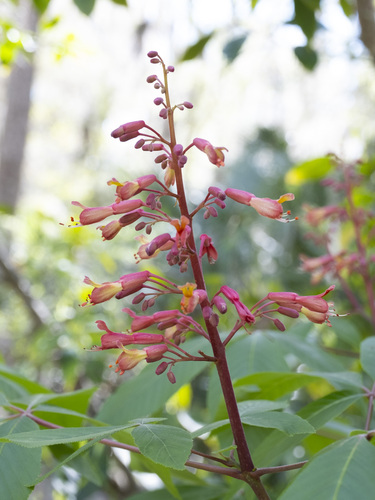
Hercules' club
Zanthoxylum clava-herculis
Hercules' club is a unique plant with thick, spiky branches. It grows in warm areas and has bright green leaves that can be very pretty. This plant is named after the strong hero Hercules!
Hábitat: Coastal areas
The Hercules' club is a striking tree with a distinctive trunk covered in corky, cone-shaped thorns. Its compound leaves are shiny green, turning yellowish in fall. Small, clustered yellowish-green flowers lead to tiny, dark, capsule-like fruits.
Categoría
PlantasRareza
Common
Peligro
2/5 · Bajo
Snaps
¡Sé la primera persona en hacer un snap!
It's called "Hercules' club" because its thorny trunk looks like the legendary hero's weapon!
Its bark contains chemicals that create a buzzing, tingling feeling on your tongue!
Many butterflies, like the Giant Swallowtail, lay their eggs only on this special tree!
Some birds love to eat its tiny, black berries, helping to spread its seeds far and wide!
Hercules' club has formidable, cone-shaped thorns on its trunk that protect it from hungry herbivores.
The bark of Hercules' club contains compounds that can cause a tingling, numbing sensation, deterring pests.
Hercules' club can thrive in dry, sandy soils thanks to its deep root system, helping it survive droughts.
Papilio cresphontes
Its leaves are food for the butterfly's larvae.
Apis mellifera
Bees visit its small flowers for nectar and pollen.
Turdus migratorius
Robins consume its small, dark berries, spreading seeds.
Las plantas aromáticas producen y emiten compuestos orgánicos volátiles fragantes, a menudo como defensa o para atraer a los polinizadores.
Las plantas con flores son cualquier planta que produce flores como parte de su ciclo reproductivo.
Las plantas de hoja perenne conservan su follaje durante todo el año, sin perder nunca todas sus hojas a la vez.
Las flores fragantes emiten un aroma agradable, a menudo para atraer polinizadores o como defensa.

Las plantas medicinales poseen compuestos químicos que pueden utilizarse con fines terapéuticos para tratar enfermedades o mantener la salud.

Los árboles de hoja ancha son angiospermas caracterizadas por hojas planas y anchas que típicamente se caen anualmente en climas templados.

Posee proyecciones puntiagudas y afiladas o espinas en el cuerpo o en la superficie.

Los hábitats costeros son entornos dinámicos situados a lo largo de la interfaz entre la tierra y el mar, influenciados por las mareas, las olas y el agua salada.

El estado de peligro de extinción indica que una especie corre un riesgo muy alto de extinguirse en estado silvestre en un futuro próximo.
Peligro
2/5 · Bajo
Be careful around the spiky branches; they can be sharp!
1000-1800 cm
400-800 cm
0.2-0.5 cm
Late spring to early summer
No
Leve
Perenne
Insectos
Acércate para separar los grupos y explorar dónde se ha fotografiado este objeto.
Los snaps recientes aparecerán aquí a medida que se añadan nuevas observaciones.