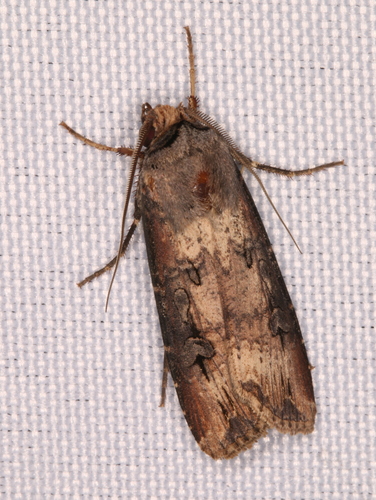


Ipsilon Dart Moth
agrotis ipsilon
The Ipsilon Dart Moth, Agrotis ipsilon, is a highly adaptable and globally distributed noctuid moth. While its adult form is a drab, nocturnal insect, its larval stage, commonly known as the black cutworm, is notorious in agriculture. This species is a significant pest of many crops worldwide due to its destructive feeding habits as a caterpillar, often severing young plants at ground level. Its impressive migratory capabilities allow it to colonize new areas annually, making it a persistent challenge for farmers across temperate regions, as it can cause widespread damage to emerging seedlings.
Hábitat: This moth is highly versatile, found in a wide range of open and disturbed habitats, particularly agricultural fields, gardens, pastures, and disturbed grasslands.
The adult Ipsilon Dart Moth typically measures 3.5 to 5.0 cm in wingspan. Its forewings are mottled shades of brown, grey, and black, providing excellent camouflage against tree bark or soil. A key identifying feature is the dark, dagger-shaped or “Y”-shaped (ipsilon) mark located near the kidney-shaped spot on each forewing, which gives the species its common name. The hindwings are paler, often whitish to light grey with darker veins and a slight dusky margin. The body is robust and covered in fine hairs, characteristic of many noctuid moths.
Categoría
InsectosRareza
Common
Peligro
1/5 · Muy bajo
Snaps
¡Sé la primera persona en hacer un snap!
Adult Ipsilon Dart Moths are powerful migrants, capable of traveling hundreds or even thousands of kilometers from their overwintering grounds to summer breeding areas.
Female moths can lay between 1,000 and 2,000 eggs, often individually on plant leaves or stems, contributing to their rapid population growth.
The common name 'cutworm' refers to the larva's habit of cutting down young plants at the soil surface, causing them to wilt and die.
They are known to be active on warm, humid nights and are strongly attracted to artificial lights, making them a common sight around outdoor illumination.
The adult moths are strong flyers capable of migrating thousands of kilometers, often riding warm air currents from southern overwintering grounds to northern breeding areas.
The larvae, known as cutworms, have a distinctive feeding behavior where they sever young plant stems at or just below the soil surface, causing significant damage to emerging crops.
Both adult moths and larvae exhibit excellent camouflage. Adults are nocturnally active, blending into their surroundings during the day, while larvae are typically hidden in the soil during daylight hours, emerging to feed at night.
The larval stage (cutworm) is polyphagous, feeding on a wide variety of plant stems and roots, often cutting them at the soil line. Adult moths primarily feed on nectar from various flowers, providing energy for flight and reproduction.
Diferencias por edad: Larvae consume plant material, while adults primarily consume liquid nectar.
Carabidae
Larvae are prey for various ground beetles.
Erithacus rubecula
Adult moths and larvae are food for insectivorous birds.
Zea mays
A common host plant for the larval stage.
Microplitis croceipes
Larvae are parasitized by certain braconid wasps.
Aún no hay insignias de rasgos asignadas a este objeto.
Todavía no hay alias listados.
Las colecciones para este objeto aparecerán aquí a medida que se añadan más temas.
Peligro
1/5 · Muy bajo
Todavía no hay notas especiales de seguridad.
La forma más fácil de identificar a Ipsilon Dart Moth es usar la aplicación de identificación de naturaleza Snappit.
2-3 cm
3-5 cm
0.0005-0.002 kg
0 años
The larval stage (cutworm) is polyphagous, feeding on a wide variety of plant stems and roots, often cutting them at the soil line. Adult moths primarily feed on nectar from various flowers, providing energy for flight and reproduction.
This moth is highly versatile, found in a wide range of open and disturbed habitats, particularly agricultural fields, gardens, pastures, and disturbed grasslands.
Foraging (larvae), Grazing (larvae), Nectar Feeding (adults)
Acércate para separar los grupos y explorar dónde se ha fotografiado este objeto.
Los snaps recientes aparecerán aquí a medida que se añadan nuevas observaciones.













.jpg&width=800)
