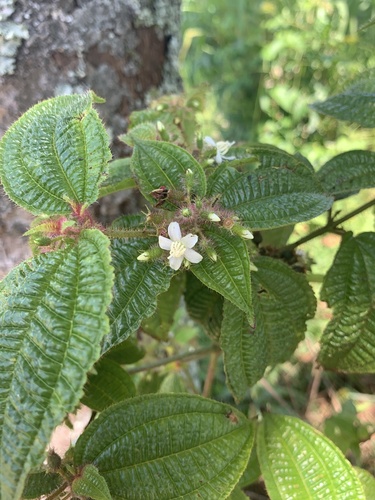


Koster'S Curse
miconia crenata
Koster's Curse (Miconia crenata, formerly Clidemia hirta) is a notorious perennial shrub native to the tropical Americas that has earned a reputation as one of the world's most aggressive invasive plant species. Thriving in warm, humid climates, this fast-growing understory plant quickly forms dense, impenetrable thickets that block sunlight and crowd out native flora. While its dark blue-purple berries and fuzzy leaves may look appealing, they are a harbinger of ecological disruption in regions like Hawaii, Australia, and parts of Asia where it has been introduced. In its native range, the plant is kept in check by local herbivores and pathogens. However, when introduced to new territories without these natural predators, it spreads relentlessly. This resilience makes Koster's Curse a key subject for ecological studies focusing on biological control and invasive species management, serving as a powerful reminder of how human-mediated transport can alter ecosystems.
Hábitat: Found in tropical rainforest understories, disturbed forest margins, riparian zones, and moist pastures.
This erect shrub typically grows between 50 and 300 centimeters tall, easily identified by its distinctive hairy stems and leaves. The opposite, egg-shaped green leaves have finely scalloped margins and feature five prominent longitudinal veins running from the base to the tip. Both the leaves and the reddish stems are densely covered in stiff, bristly hairs. It produces small, cluster-borne white or pale pink flowers with five petals, which develop into rounded, hairy berries that ripen from green to a deep, dark blue-purple or black.
Categoría
PlantasRareza
Common
Peligro
1/5 · Muy bajo
Snaps
¡Sé la primera persona en hacer un snap!
In Hawaii, it has spread to cover over 100,000 acres, threatening many endangered native Hawaiian plants and animals by completely changing the understory habitat.
It is recognized as one of the 'World's 100 Worst Invasive Alien Species' by the IUCN due to its devastating impact on native ecosystems.
The common name 'Koster's Curse' stems from William Koster, who accidentally introduced the plant to Fiji in the late 19th century, leading to a massive agricultural headache.
A single mature plant can produce thousands of seeds per year, allowing it to rapidly build up a massive seed bank in the soil.
It can survive and photosynthesize in deep forest shade, waiting for a canopy gap to open before growing rapidly to dominate the space.
If damaged by fire, cutting, or grazing, Koster's Curse can quickly sprout back from its root crown or stem fragments.
As a photosynthetic plant, it generates its own energy from sunlight, water, and carbon dioxide while absorbing essential minerals from the soil.
Lius poseidon
The larvae of this buprestid beetle mine the leaves of the plant, acting as a biological control agent.
Zosterops japonicus
This bird feeds on the dark berries and inadvertently disperses the seeds across Hawaiian forests.
Colletotrichum gloeosporioides f. sp. clidemiae
A pathogenic fungus introduced in Hawaii as a biocontrol agent that causes leaf spots and defoliation.
Aún no hay insignias de rasgos asignadas a este objeto.
Todavía no hay alias listados.
Las colecciones para este objeto aparecerán aquí a medida que se añadan más temas.
Peligro
1/5 · Muy bajo
Todavía no hay notas especiales de seguridad.
La forma más fácil de identificar a Koster'S Curse es usar la aplicación de identificación de naturaleza Snappit.
50-300 cm
5-15 años
As a photosynthetic plant, it generates its own energy from sunlight, water, and carbon dioxide while absorbing essential minerals from the soil.
Found in tropical rainforest understories, disturbed forest margins, riparian zones, and moist pastures.
Acércate para separar los grupos y explorar dónde se ha fotografiado este objeto.
Los snaps recientes aparecerán aquí a medida que se añadan nuevas observaciones.

Hawaii, US
Puedes ver White-Rumped Shama, Koster's Curse y Red Button Ginger.
Ver guía →

Hawaii, US
Puedes ver Bastón De Emperador, Red-Crested Cardinal y African Tulip Tree.
Ver guía →

Hawaii, US
Puedes ver Koster's Curse, White-Rumped Shama y Australian Umbrella Tree.
Ver guía →










