

Nassaquatuck Seapill
sphaeroma papillae
The Nassaquatuck Seapill is a fascinating marine isopod, often affectionately referred to as a "marine pillbug." Found predominantly in the brackish waters, salt marshes, and estuarine environments of the northeastern North American coast, it plays a vital but often overlooked role in coastal ecosystems by breaking down decaying plant matter. What makes it particularly interesting is its ability to conglobate—meaning it can roll into a perfect, armored sphere when threatened, just like its terrestrial woodlouse cousins. These resilient, highly adaptable little crustaceans are typically discovered clinging to submerged rocks, marsh grass stalks, and driftwood, quietly recycling nutrients back into the estuarine food web.
Hábitat: Primarily found in estuarine habitats, salt marshes, and shallow intertidal zones along the northeastern North American coast, clinging to rocks, pilings, and decaying cordgrass.
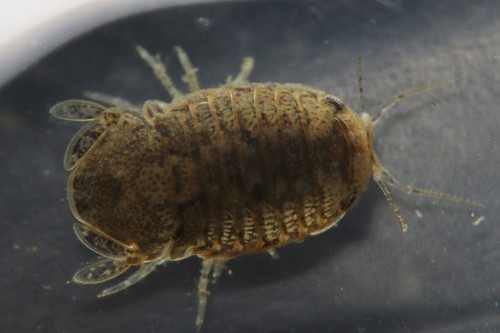
This small, robust crustacean measures about 1 to 1.5 centimeters in length. Its body is composed of overlapping, highly arched calcareous plates that are typically mottled with shades of slate gray, olive brown, and speckled black to provide camouflage against muddy bottoms and algae-covered rocks. The most defining visual characteristic is its broad, dome-shaped posterior (the pleotelson), which is studded with tiny, textured bumps (papillae) that give the species its scientific name. It features prominent, sweeping antennae and multiple pairs of short, grasping legs tightly tucked beneath its segmented carapace.
Categoría
AnimalRareza
Common
Peligro
1/5 · Muy bajo
Snaps
¡Sé la primera persona en hacer un snap!
Even though they live completely underwater, Nassaquatuck Seapills share a very close evolutionary relationship with the common terrestrial pillbugs (roly-polies) you find in your garden.
Like kangaroos, female seapills carry their developing eggs and hatched young in a specialized brood pouch on their underside, completely protecting them from the outside ocean.
The word 'papillae' in their scientific name refers to the tiny bumps on their rear end, which help break up their outline and blend in perfectly with textured rocks and sand.
They act as important 'ecosystem engineers,' chewing up tough plant material into finer particles that smaller marine organisms can easily consume.
When threatened by predators or exposed to dry air during low tide, it curls into a tight, armored ball to protect its vulnerable underside.
Possesses a high tolerance for wildly fluctuating salinity levels, allowing it to thrive in both brackish estuaries and fully marine environments.
Females possess a specialized fluid-filled pouch called a marsupium, where they incubate their eggs and carry their newly hatched young until they are ready to forage.
It feeds almost exclusively on decaying organic matter, scraping biofilms and breaking down rotting vegetation in the intertidal zone.
Diferencias por edad: Juveniles consume softer biofilms and fine detrital particles, while adults use stronger mandibles to tackle tougher, fibrous decaying plant matter.

Fundulus heteroclitus
Commonly preyed upon by small estuarine fish foraging in the shallows.
Idotea balthica
Competes for decaying algae and plant matter in overlapping estuarine and intertidal habitats.
Spartina alterniflora
Relies heavily on the decaying blades and stalks of this grass for both food and shelter.
Aún no hay insignias de rasgos asignadas a este objeto.
Todavía no hay alias listados.
Las colecciones para este objeto aparecerán aquí a medida que se añadan más temas.
Peligro
1/5 · Muy bajo
Todavía no hay notas especiales de seguridad.
La forma más fácil de identificar a Nassaquatuck Seapill es usar la aplicación de identificación de naturaleza Snappit.
1-2 cm
0.0001-0.0005 kg
1-3 años
0 km/h
It feeds almost exclusively on decaying organic matter, scraping biofilms and breaking down rotting vegetation in the intertidal zone.
Primarily found in estuarine habitats, salt marshes, and shallow intertidal zones along the northeastern North American coast, clinging to rocks, pilings, and decaying cordgrass.
Foraging
Acércate para separar los grupos y explorar dónde se ha fotografiado este objeto.
Los snaps recientes aparecerán aquí a medida que se añadan nuevas observaciones.




