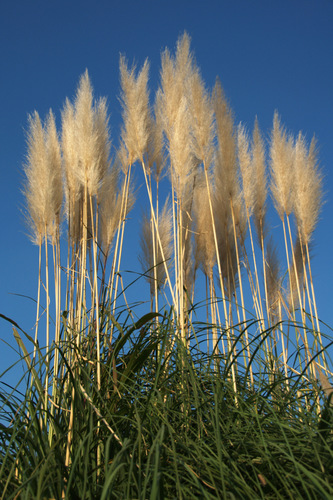


Pampas Grasses
cortaderia
Pampas Grasses, scientifically known as Cortaderia, are large, clumping perennial grasses native to South America, particularly the pampas region. These striking plants are widely recognized for their tall, feathery plumes, which make them a popular ornamental choice in gardens worldwide. However, their beauty belies a formidable invasive nature. Once established, Cortaderia species can spread rapidly, outcompeting native vegetation and altering ecosystems, especially in coastal areas and disturbed sites. Their resilience, rapid growth, and prolific seed production contribute to their success as invaders, posing significant ecological and management challenges in many regions outside their native range.
Hábitat: Pampas Grasses are typically found in open grasslands, coastal dunes, disturbed areas, roadsides, and riverbanks, thriving in full sun and well-drained soils.
Pampas Grasses are characterized by their dense, tussock-forming growth habit, producing large clumps that can reach impressive sizes. The leaves are long, thin, and sharply serrated, often with a bluish-green hue, forming dense basal mounds. The most distinctive feature is the erect flowering stalks, which can soar to heights of 2-4 meters, topped with large, feathery, plume-like inflorescences. These plumes vary in color from silvery-white to cream, pink, or purplish, and are particularly prominent from late summer through winter, giving the plant its iconic appearance.
Categoría
PlantasRareza
Common
Peligro
1/5 · Muy bajo
Snaps
¡Sé la primera persona en hacer un snap!
The name 'pampas grass' refers to the Pampas region of South America, its native habitat, which is characterized by vast fertile grasslands.
The sharp, serrated edges of Pampas Grass leaves can easily cut skin, earning them the nickname 'cutty grass' in some regions.
The silky plumes are often dried and used in floral arrangements, a popular practice that sometimes inadvertently contributes to the plant's spread if fertile seeds are present.
While some species of Cortaderia, like Cortaderia selloana, are highly invasive, other species such as Cortaderia jubata (Andean pampas grass) are also problematic weeds.
Cortaderia species are fast-growing and can quickly establish themselves in disturbed or open ground, forming dense monocultures that outcompete native plants for resources.
These grasses are highly adaptable, tolerating a wide range of environmental conditions including prolonged drought, poor soils, and coastal salt spray, enabling them to thrive in harsh environments.
A single mature plant can produce millions of lightweight, wind-dispersed seeds annually, facilitating widespread dispersal and rapid establishment of new populations over large areas.
As a plant, Pampas Grasses produce their own food through photosynthesis, utilizing sunlight, carbon dioxide from the air, and water and nutrients absorbed from the soil.
Various native Poaceae species
Competition for resources, displacement of native vegetation in invasive regions.
Callipepla californica
Provides dense cover and nesting sites, but can reduce open habitat for other species.
N/A
Serves as a fuel source, increasing fire intensity and frequency in ecosystems where it is invasive.
Bos taurus
Often avoided by grazing animals due to sharp leaf margins, impacting forage availability.
Aún no hay insignias de rasgos asignadas a este objeto.
Todavía no hay alias listados.
Las colecciones para este objeto aparecerán aquí a medida que se añadan más temas.
Peligro
1/5 · Muy bajo
Todavía no hay notas especiales de seguridad.
La forma más fácil de identificar a Pampas Grasses es usar la aplicación de identificación de naturaleza Snappit.
150-300 cm
10-20 años
As a plant, Pampas Grasses produce their own food through photosynthesis, utilizing sunlight, carbon dioxide from the air, and water and nutrients absorbed from the soil.
Pampas Grasses are typically found in open grasslands, coastal dunes, disturbed areas, roadsides, and riverbanks, thriving in full sun and well-drained soils.
Absorption
Acércate para separar los grupos y explorar dónde se ha fotografiado este objeto.
Los snaps recientes aparecerán aquí a medida que se añadan nuevas observaciones.




.jpg&width=800)












