






Rainbow boa
Epicrates cenchria
The rainbow boa is a colorful snake known for its beautiful scales that shine in the light. It is friendly and loves to live in warm, tropical places like rainforests.
Hábitat: Rainforests
The Rainbow boa has smooth, iridescent scales that shimmer with all the colours of the rainbow, especially in bright light. Its body is typically reddish-brown to orange with distinct dark saddles and spots along its back and sides, creating a striking pattern.
Categoría
ReptilesRareza
Common
Peligro
2/5 · Bajo
Snaps
¡Sé la primera persona en hacer un snap!
Instead of laying eggs, Rainbow boas give birth to fully formed, live baby snakes!
Rainbow boas are nocturnal hunters, silently stalking prey under the cover of night!
They have tiny 'spurs' near their tail, remnants of hind legs from ancient snake ancestors!
Wow! The rainbow shimmer on their scales comes from special microstructures, not pigments!
Rainbow boa has scales that sparkle like a rainbow, helping them blend into their diverse rainforest environment as sunlight filters through leaves.
Rainbow boa can sense the body heat of prey using special pits on its snout, allowing it to hunt effectively in the dark.
Rainbow boa can squeeze prey with immense strength, quickly immobilizing small animals before swallowing them whole.
These nocturnal predators feast on small mammals and birds found in their forest homes.
Proechimys cayennensis
Mainly hunts these rodents in tropical forests.
Coereba flaveola
Actively preys on small birds, including this common species.
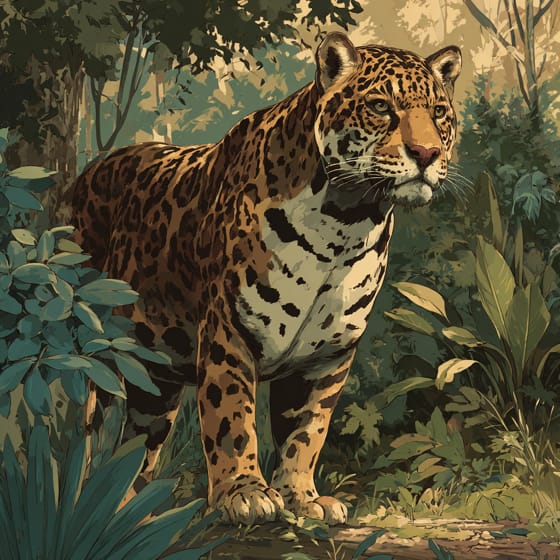
Panthera onca
May fall prey to this large, powerful feline predator.
Marcado con bandas paralelas o líneas de color.
Los animales solitarios viven solos durante la mayor parte de su vida y solo interactúan con otros para aparearse o cuidar de sus crías.
Los animales arborícolas viven principalmente en los árboles, utilizándolos como refugio, alimento y protección contra los depredadores.
Colorido describe a organismos u objetos que exhiben una amplia variedad de colores brillantes y distintivos.

Este rasgo de hábitat se refiere a las especies que se encuentran en las selvas tropicales, caracterizadas por una alta precipitación anual, gran biodiversidad y una densa cubierta arbórea.

Este rasgo identifica a los organismos cuya dieta consiste total o principalmente en tejido animal.
Peligro
2/5 · Bajo
Always keep a safe distance from snakes and never try to touch them without an adult.
120-180 cm
1-3 kg
15-20 años
8 km/h
These nocturnal predators feast on small mammals and birds found in their forest homes.
Rainforests
Ambush
3-30
Acércate para separar los grupos y explorar dónde se ha fotografiado este objeto.
Los snaps recientes aparecerán aquí a medida que se añadan nuevas observaciones.

Nebraska, US
Puedes ver León Africano, Jirafas y Tigre.
Ver guía →

Texas, US
Puedes ver Foca Común, Pingüino Barbijo y Cotton-Top Tamarin.
Ver guía →

District of Columbia, US
Puedes ver Grevy's Zebra, Eastern Long-Necked Turtle y Sitatunga.
Ver guía →














