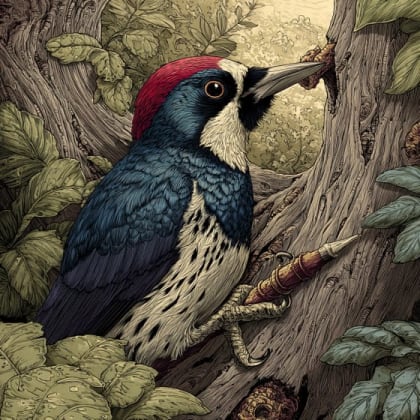
Rose-breasted Grosbeak
Pheucticus ludovicianus
The Rose-breasted Grosbeak is a colorful bird with a bright pink chest and black wings. They love to sing beautiful songs and can often be seen in gardens and forests.
Hábitat: Forests
The Rose-breasted Grosbeak male has a striking black head and back, with a triangular rose-red patch on a white breast. Females and immatures are streaky brown with a strong supercilium, and both sexes show a flash of yellow under their wings in flight.
Categoría
AvesRareza
Common
Peligro
1/5 · Muy bajo
Snaps
¡Sé la primera persona en hacer un snap!
Females have a unique yellow flash under their wings when flying!
Males sing beautiful songs even while incubating eggs on the nest!
Their thick beak can crush cherry pits with surprising strength!
They fly thousands of kilometers between continents each year!
Rose-breasted Grosbeaks have a powerful, conical beak that helps them crack open tough seeds and fruit pits with ease.
Rose-breasted Grosbeaks can eat Monarch butterflies, which are toxic to many birds, because of special adaptations.
Rose-breasted Grosbeaks can migrate thousands of kilometers by flying mostly at night, using celestial cues to guide them.
These birds enjoy a varied diet of insects, seeds, and fruits, helping control garden pests.
Malacosoma americanum
Feeds on these common forest pests.
Prunus serotina
Crushes and consumes seeds and pulp from its fruits.
Danaus plexippus
One of few birds able to eat toxic Monarchs.
Accipiter cooperii
A common avian predator of smaller songbirds.
Describe a los animales, principalmente aves, que poseen una cubierta de plumas.
Los animales sociales viven en grupos organizados, cooperando para obtener beneficios de supervivencia como la búsqueda de alimento, la defensa y la cría de descendencia.
Los animales cantores producen vocalizaciones complejas, a menudo con el propósito de atraer parejas, defender el territorio o comunicarse dentro de su especie.
Este rasgo identifica organismos cuya dieta incluye tanto materia vegetal como animal.

Colorido describe a organismos u objetos que exhiben una amplia variedad de colores brillantes y distintivos.

Los hábitats boscosos son entornos terrestres dominados por una densa cubierta arbórea, que sustentan una gran diversidad de vida animal y vegetal.

Los animales diurnos están activos principalmente durante el día y suelen descansar o dormir por la noche.

Describe organismos que transfieren polen, permitiendo la fertilización y reproducción de las plantas.
Peligro
1/5 · Muy bajo
Enjoy watching birds from a distance and don't try to touch them.
18-20 cm
29-33 cm
0.035-0.049 kg
3-10 años
50 km/h
These birds enjoy a varied diet of insects, seeds, and fruits, helping control garden pests.
Forests
Foraging
Acércate para separar los grupos y explorar dónde se ha fotografiado este objeto.
Los snaps recientes aparecerán aquí a medida que se añadan nuevas observaciones.







.jpg&width=800)