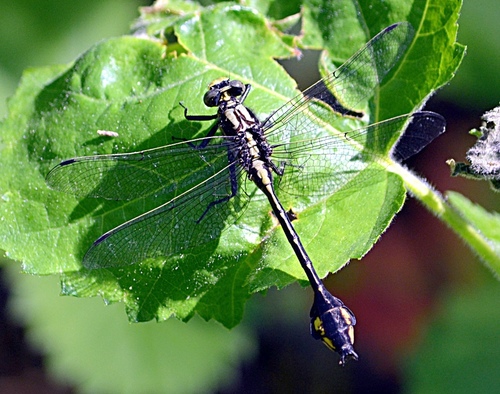


Skillet Clubtail
gomphurus ventricosus
The Skillet Clubtail (Gomphurus ventricosus) is a striking and highly specialized dragonfly native to the clean, flowing rivers of eastern North America. What immediately sets this insect apart is its remarkable anatomy: the end of its abdomen features an extraordinarily wide, flat expansion that resembles a skillet, which serves as a stabilizing rudder during its acrobatic flights. It belongs to the clubtail family, known for their bright eyes that do not meet at the top of the head. Finding a Skillet Clubtail is always a treat for nature enthusiasts, as they are highly sensitive indicators of clean water. These nimble aerial predators spend their days patrolling riverbanks, hunting for flying insects, and resting on sunny shoreline rocks or leaves. Because they require pristine, silt-laden flowing waters for their aquatic larval phase, their presence signals a healthy, unpolluted river ecosystem.
Hábitat: Found near clean, medium-to-large flowing rivers with silt, sand, or gravel substrates, often resting on sunny rocks or riverside foliage.
The Skillet Clubtail is a medium-sized dragonfly, measuring between 4 and 6 centimeters in length. Its most defining characteristic is the dramatically flared abdomen tip, which is nearly circular, dark brown to black, and often marked with small yellow spots on the sides. The thorax is patterned with bright yellow-green and black stripes, while its clear wings stretch to a span of approximately 5 to 7 centimeters. Unlike many other dragonfly families, its large, green compound eyes are distinctly separated on the top of its head.
Categoría
InsectosRareza
Common
Peligro
1/5 · Muy bajo
Snaps
¡Sé la primera persona en hacer un snap!
Because they require exceptionally clean, flowing water to breed, the presence of Skillet Clubtails is used by ecologists as a biological indicator of high water quality.
The dramatic, skillet-shaped widening at the end of the abdomen is much more pronounced in males than in females, serving as a visual signal during territorial flights.
They spend the vast majority of their lives—up to four years—as aquatic nymphs crawling along the river bottom, while their adult aerial life lasts only a few short weeks.
Uses its uniquely widened, flat abdominal club as a physical rudder to make sharp, high-speed banking turns while chasing prey in mid-air.
Possesses massive, widely separated compound eyes that allow it to track fast-moving prey and detect incoming predators from almost any angle.
As an aquatic nymph, it burrows into river sediment and uses a specialized, extendable lower lip to capture passing prey with lightning speed.
Opportunistic aerial predators as adults that capture flying insects mid-air, while their aquatic nymphs ambush small invertebrates in riverbed sediment.
Diferencias por edad: Aquatic nymphs feed on bottom-dwelling invertebrates and tiny fish, whereas terrestrial adults hunt flying insects in the air.
Bombycilla cedrorum
Adult clubtails are frequently preyed upon by insectivorous birds nesting along river corridors.
Micropterus dolomieu
The aquatic larvae (nymphs) live in river gravel and are a common food source for benthic-feeding river fish.
Calopteryx maculata
Both species patrol the same riverbank zones, competing for aerial insects like midges and blackflies.
Aún no hay insignias de rasgos asignadas a este objeto.
Todavía no hay alias listados.
Las colecciones para este objeto aparecerán aquí a medida que se añadan más temas.
Peligro
1/5 · Muy bajo
Todavía no hay notas especiales de seguridad.
La forma más fácil de identificar a Skillet Clubtail es usar la aplicación de identificación de naturaleza Snappit.
4+ cm
5+ cm
0.0001+ kg
2+ años
35 km/h
Opportunistic aerial predators as adults that capture flying insects mid-air, while their aquatic nymphs ambush small invertebrates in riverbed sediment.
Found near clean, medium-to-large flowing rivers with silt, sand, or gravel substrates, often resting on sunny rocks or riverside foliage.
Acércate para separar los grupos y explorar dónde se ha fotografiado este objeto.
Los snaps recientes aparecerán aquí a medida que se añadan nuevas observaciones.




_(7437712788).jpg&width=800)










