






Southern Cricket Frog
Acris gryllus
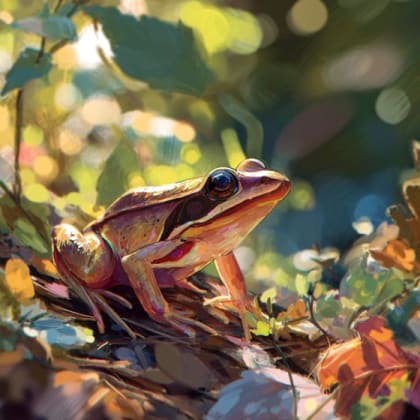
The Southern Cricket Frog is a small, lively frog that loves to hop around. They make a funny sound that sounds like a cricket, especially during warm days and nights.
Hábitat: Wetlands
The Southern Cricket Frog is a tiny amphibian, typically green, brown, or gray, with rough, warty skin. It often has a distinct dark triangle mark between its eyes and dark stripes on its legs, making it visually distinct from smooth-skinned frogs.
Categoría
AnfibiosRareza
Common
Peligro
1/5 · Muy bajo
Snaps
¡Sé la primera persona en hacer un snap!
Look for a dark triangle mark often between their eyes, a secret symbol!
The Southern Cricket Frog is one of the smallest frogs in North America!
Their chirping call sounds exactly like crickets rubbing their legs together!
These tiny frogs can lay hundreds of eggs in a single breeding season!
Southern Cricket Frog can jump up to 6 feet, about 60 times its body length, to escape danger quickly.
Southern Cricket Frog has a distinct call, sounding like crickets clicking, that helps them find mates.
Southern Cricket Frog can change its skin color (green, brown, or gray) to perfectly blend into its surroundings.
These tiny frogs gobble up small insects, spiders, and other tiny creatures they find nearby.
Diferencias por edad: Tadpoles eat algae and detritus; adults are insectivores.
Thamnophis sirtalis
Common Garter Snakes prey on these small frogs.
Lithobates catesbeianus
Larger bullfrogs frequently ambush smaller cricket frogs.

Ardea alba
Great Egrets stalk shallow water to catch frogs.
Drosophila melanogaster
Southern Cricket Frogs hunt small fruit flies.
Los animales sociales viven en grupos organizados, cooperando para obtener beneficios de supervivencia como la búsqueda de alimento, la defensa y la cría de descendencia.
El camuflaje describe a los organismos que poseen colores o patrones que les permiten mezclarse con su entorno.
Este rasgo identifica a los organismos cuya dieta consiste principalmente en insectos y otros pequeños invertebrados.
Este rasgo de hábitat identifica especies que se encuentran en humedales, que son áreas de tierra saturadas de agua, ya sea permanente o estacionalmente, e incluyen marismas, pantanos y ciénagas.

Los hábitats de agua dulce incluyen entornos acuáticos no salinos como ríos, lagos, estanques y humedales, vitales para numerosas especies.

Los animales diurnos están activos principalmente durante el día y suelen descansar o dormir por la noche.

Este rasgo identifica a los organismos que exhiben una rapidez excepcional en sus movimientos para cazar, escapar o desplazarse.

Los animales nocturnos están principalmente activos durante la noche, y suelen descansar o dormir durante el día.

Describe organismos que transfieren polen, permitiendo la fertilización y reproducción de las plantas.
Todavía no hay alias listados.
Peligro
1/5 · Muy bajo
Always watch where you step when near water to protect frogs and other animals.
1.5-3.8 cm
0.002-0.008 kg
1-2 años
0.5 km/h
These tiny frogs gobble up small insects, spiders, and other tiny creatures they find nearby.
Wetlands
Ambush
200-400
Acércate para separar los grupos y explorar dónde se ha fotografiado este objeto.
Los snaps recientes aparecerán aquí a medida que se añadan nuevas observaciones.

North Carolina, US
Puedes ver Spiny Spikemoss, Laurel De Montaña y Longleaf Pine.
Ver guía →

Mississippi, US
Puedes ver Golden Club, Southern Cricket Frog y Dwarf Sundew.
Ver guía →

North Carolina, US
Puedes ver Cipreses Calvos, Southern Cricket Frog y Green Treefrog.
Ver guía →






.jpg&width=800)







