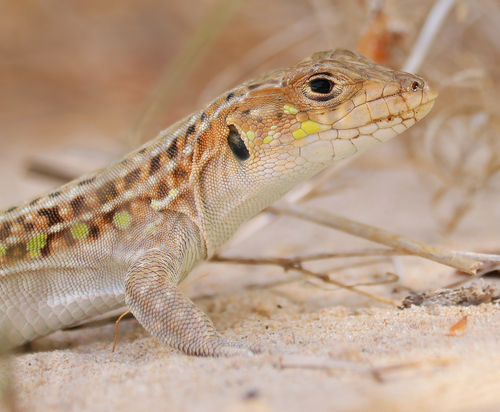


Spiny-Footed Lizard
acanthodactylus erythrurus
The Spiny-Footed Lizard, Acanthodactylus erythrurus, is a swift and agile reptile perfectly adapted to life in sandy, open habitats across the Iberian Peninsula and Northwest Africa. These fascinating lizards are known for their distinctively fringed toes, which act like natural snowshoes, allowing them to traverse loose sand with remarkable speed and efficiency. They are primarily insectivorous, playing an important role in controlling insect populations within their ecosystems. Often seen basking in the sun or darting between vegetation, they embody the vibrant life of their arid and semi-arid environments.
Hábitat: Found in various open, arid to semi-arid habitats, particularly sandy areas such as coastal dunes, inland sand sheets, pine forests with sandy substrates, and scrublands.
This medium-sized lizard typically reaches a total length of 15-25 cm, including its long tail. Its slender body is usually sandy-brown, grey, or reddish-brown, often adorned with dark spots, streaks, or longitudinal stripes that aid in camouflage. The belly is uniformly whitish. A key identifying feature is the presence of prominent spiny scales on its toes, which give it its common name. The tail, especially in juveniles and some adult populations, can display a striking reddish or orange hue.
Categoría
ReptilesRareza
Common
Peligro
1/5 · Muy bajo
Snaps
¡Sé la primera persona en hacer un snap!
Its 'spiny feet' are not actually spines for defense, but rather elongated, fringed scales that act like miniature snowshoes, helping it run across loose sand without sinking.
Juvenile Spiny-Footed Lizards often display a vibrant red or orange tail, which may serve as a distraction to predators, drawing attention away from their vital body parts.
They are extremely heliothermic, meaning they rely heavily on basking in the sun to raise their body temperature to optimal levels for activity, often retreating to shade or burrows when it gets too hot.
When threatened, they often exhibit a characteristic 'tail-waving' display before rapidly darting away to safety.
The specialized, spiny scales on its toes increase the surface area of its feet, providing superior traction and preventing it from sinking into loose sand, enabling rapid movement across its sandy habitat.
Utilizing its modified toes, the Spiny-Footed Lizard can quickly dig shallow burrows. These serve as crucial shelters from predators and extreme temperatures, especially during the hottest parts of the day or overnight.
Known for its incredible speed and agility, this lizard can dart quickly across open ground to evade predators or pursue fast-moving insect prey, making it a challenging target for both. It exhibits bursts of high-speed running.
The Spiny-Footed Lizard is an active insectivore, primarily feeding on a diverse range of small invertebrates found within its sandy environment. It actively hunts its prey, relying on its keen eyesight and speed.
Malpolon monspessulanus
A primary predator of the Spiny-Footed Lizard.
Lasius niger
A common prey item in the lizard's diet.
Falco tinnunculus
A raptor that preys on various small reptiles, including the Spiny-Footed Lizard.
Carabidae
Another common prey item for this lizard.
Aún no hay insignias de rasgos asignadas a este objeto.
Todavía no hay alias listados.
Las colecciones para este objeto aparecerán aquí a medida que se añadan más temas.
Peligro
1/5 · Muy bajo
Todavía no hay notas especiales de seguridad.
La forma más fácil de identificar a Spiny-Footed Lizard es usar la aplicación de identificación de naturaleza Snappit.
15-25 cm
0.01-0.025 kg
3-5 años
30 km/h
The Spiny-Footed Lizard is an active insectivore, primarily feeding on a diverse range of small invertebrates found within its sandy environment. It actively hunts its prey, relying on its keen eyesight and speed.
Found in various open, arid to semi-arid habitats, particularly sandy areas such as coastal dunes, inland sand sheets, pine forests with sandy substrates, and scrublands.
Pursuit
Acércate para separar los grupos y explorar dónde se ha fotografiado este objeto.
Los snaps recientes aparecerán aquí a medida que se añadan nuevas observaciones.

















_-_Flickr_-_2ndPeter_(2).jpg&width=800)
