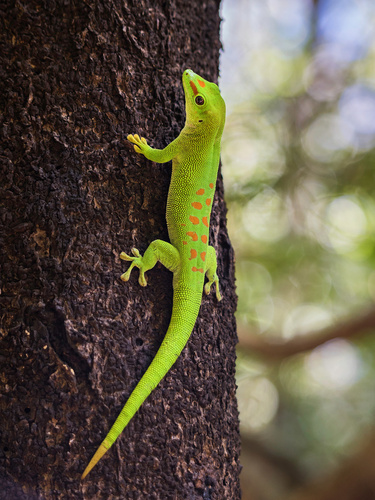
.jpg&width=800)





Tropical House Gecko
Hemidactylus mabouia
The Tropical House Gecko is a small lizard that loves to live in warm places. They have soft skin and can change color a little to blend in with their surroundings.
Hábitat: Urban areas
The Tropical House Gecko is a small, slender lizard, typically light gray to tan, often with darker spots or blotches. Its skin can appear almost translucent on the underside. Unlike many lizards, it has large, immovable eyes with vertical pupils.
Categoría
ReptilesRareza
Common
Peligro
1/5 · Muy bajo
Snaps
¡Sé la primera persona en hacer un snap!
Their skin is nearly see-through on their bellies, sometimes revealing organs!
These geckos shed their entire skin in one piece and often eat it afterwards!
They can change their skin color slightly to blend into different backgrounds!
They don't have eyelids; they lick their eyes to keep them clean!
Tropical House Gecko has specialized toe pads with millions of tiny hairs that help them stick to almost any surface, even upside down.
Tropical House Gecko can voluntarily drop its tail if caught by a predator, that helps them escape while the tail wiggles to distract.
Tropical House Gecko has excellent night vision because of specialized eye structures that help them spot insects in very low light.
Tropical House Gecko can make chirping and clicking sounds that helps them communicate with other geckos for mating or territory.
These small geckos mostly eat tiny insects and spiders, helping to keep bug populations in check!
Felis catus
Common predator in urban areas.
Oxybelis aeneus
Snake species that preys on geckos.
Argiope aurantia
Preys on various small insects.
Musca domestica
Common insect prey for geckos.
Los animales sociales viven en grupos organizados, cooperando para obtener beneficios de supervivencia como la búsqueda de alimento, la defensa y la cría de descendencia.
Los animales arborícolas viven principalmente en los árboles, utilizándolos como refugio, alimento y protección contra los depredadores.
El camuflaje describe a los organismos que poseen colores o patrones que les permiten mezclarse con su entorno.
Este rasgo identifica a los organismos cuya dieta consiste principalmente en insectos y otros pequeños invertebrados.
Los organismos regenerativos poseen la capacidad de volver a desarrollar partes del cuerpo, tejidos u órganos perdidos o dañados.

Esta característica de hábitat indica especies que pueden coexistir con los humanos en entornos urbanos y suburbanos, utilizando estructuras artificiales y espacios verdes.

Los animales nocturnos están principalmente activos durante la noche, y suelen descansar o dormir durante el día.
Todavía no hay alias listados.
Peligro
1/5 · Muy bajo
Always watch geckos from a distance and do not try to catch them.
7.5-12.7 cm
0.002-0.005 kg
3-7 años
5 km/h
These small geckos mostly eat tiny insects and spiders, helping to keep bug populations in check!
Urban areas
Ambush
1-2
Acércate para separar los grupos y explorar dónde se ha fotografiado este objeto.
Los snaps recientes aparecerán aquí a medida que se añadan nuevas observaciones.