
.jpg&width=800)





Yellow-spotted river turtle
Podocnemis unifilis
The yellow-spotted river turtle is a friendly turtle that loves to swim in rivers and lakes. It has a special yellow spot on its shell that makes it easy to recognize!
Hábitat: Wetlands
The Yellow-spotted river turtle has a smooth, oval, dark brown to black shell. Its distinguishing feature is bright yellow spots on each side of its dark head. Its underside is typically a pale yellow.
Categoría
ReptilesRareza
Common
Peligro
1/5 · Muy bajo
Snaps
¡Sé la primera persona en hacer un snap!
Baby turtles hatch and make a mad dash for the river, facing many dangers!
Their eggs' gender depends on nest temperature – warm makes girls, cool makes boys!
They help spread seeds by eating fruit, acting like a jungle gardener!
Unlike many turtles, they can't pull their head straight into their shell!
Yellow-spotted river turtle's eggs have their sex determined by nest temperature, helping the population adapt to environmental changes.
Yellow-spotted river turtle can hold its breath for long periods underwater, helping it forage for plants and fruits on the riverbed.
Yellow-spotted river turtle has webbed feet and a streamlined shell that helps it glide efficiently through river currents.
These turtles eat yummy plants, fruits, and sometimes insects or small fish from the river!
Diferencias por edad: Young turtles eat more insects and small animals, while adults prefer plants and fruits.
Caiman crocodilus
Adults and juveniles are hunted by these large reptiles.
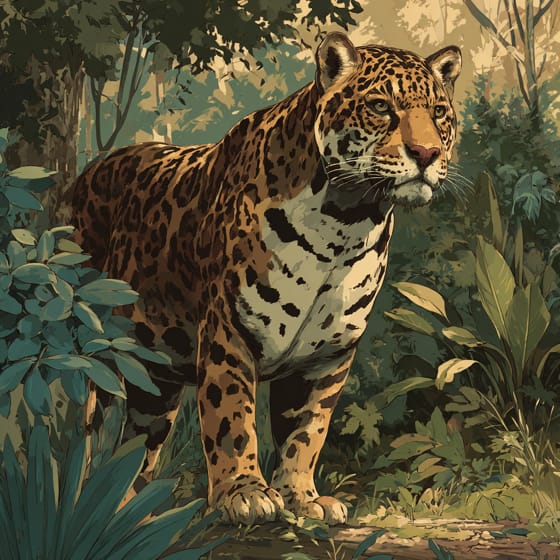
Panthera onca
Large cats prey on turtles, especially when laying eggs.
Eunectes murinus
Giant snakes can ambush turtles in their watery homes.
Ficus aurantiacae
Turtles eat its fallen fruits, helping to spread its seeds.
Marcado con manchas o parches de un color diferente.
Los animales sociales viven en grupos organizados, cooperando para obtener beneficios de supervivencia como la búsqueda de alimento, la defensa y la cría de descendencia.
Este rasgo identifica organismos cuya dieta incluye tanto materia vegetal como animal.
Este rasgo caracteriza a los organismos cuya dieta consiste total o principalmente en material vegetal.

Este rasgo de hábitat identifica especies que se encuentran en humedales, que son áreas de tierra saturadas de agua, ya sea permanente o estacionalmente, e incluyen marismas, pantanos y ciénagas.

Este rasgo caracteriza a los organismos con una esperanza de vida excepcionalmente larga en comparación con otros de su especie.

Los hábitats de agua dulce incluyen entornos acuáticos no salinos como ríos, lagos, estanques y humedales, vitales para numerosas especies.

Los animales diurnos están activos principalmente durante el día y suelen descansar o dormir por la noche.

Los hábitats acuáticos abarcan entornos donde los organismos viven principalmente en el agua, incluidos océanos, ríos, lagos y humedales.

El estado de peligro de extinción indica que una especie corre un riesgo muy alto de extinguirse en estado silvestre en un futuro próximo.
Todavía no hay alias listados.
Peligro
1/5 · Muy bajo
Always watch turtles from a distance and never try to pick them up.
30-60 cm
2-15 kg
20-50 años
0.5 km/h
These turtles eat yummy plants, fruits, and sometimes insects or small fish from the river!
8 km/h
Wetlands
Foraging
Acércate para separar los grupos y explorar dónde se ha fotografiado este objeto.
Los snaps recientes aparecerán aquí a medida que se añadan nuevas observaciones.






(found_by_Jean_NICOLAS)_(34844955103).jpg&width=800)










_playing_dead_(14178349634).jpg&width=800)
