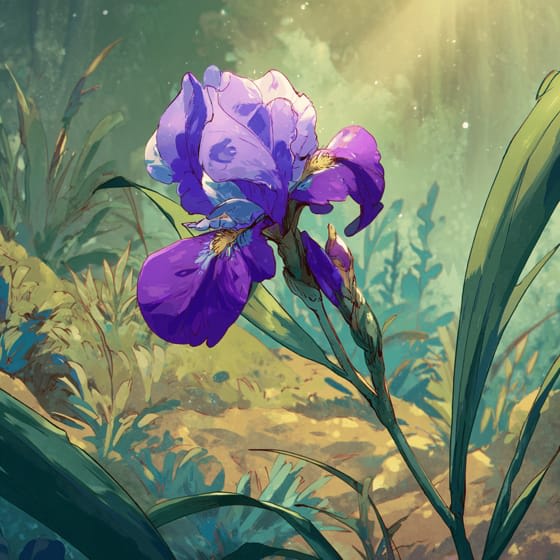





Iris
Iris
Iris flowers are beautiful and come in many colors like purple, blue, and white. They are named after the Greek goddess of the rainbow!
Habitat: Irises can be found in gardens, often near water.
The Iris has striking, often large flowers with six distinct petals: three upright 'standards' and three drooping 'falls', creating an elegant, unique shape. They come in a rainbow of colors including vibrant blues, purples, yellows, and whites, often with intricate patterns or 'beards'. Its sword-like, fan-shaped leaves grow in clumps from the base.
Category
PlantsRarity
Common
Danger
1/5 · Very low
Snaps
Be the first to snap!
Ancient Egyptians associated Irises with majesty and wisdom!
Some Irises have fuzzy 'beards' on their lower petals!
The fleur-de-lis symbol, famous in France, is based on an Iris!
There are over 300 different kinds of Iris flowers worldwide!
Iris can store water and nutrients in its thick underground rhizomes, helping it survive dry spells and cold winters.
Iris has brightly colored petals and sometimes 'nectar guides' to attract bees and other insects for successful pollination.
Some Iris species can absorb pollutants from wet soil, helping to naturally clean water in marshy areas.
Apis mellifera
Collects nectar and pollen from Iris flowers.
Bombus impatiens
Buzzes flowers, transferring pollen between them.

Arion ater
Slugs can feed on Iris leaves and young shoots.
Perennial plants live for more than two years, typically returning to grow and bloom each year from their roots.
Herbaceous plants are non-woody plants with soft stems that typically die back to the ground at the end of the growing season.
Flowering plants are any plants that produce flowers as part of their reproductive cycle.
Ornamental plants are cultivated primarily for their aesthetic appeal, enhancing landscapes and gardens with their attractive foliage, flowers, or form.

Shade tolerant plants are adapted to grow and thrive in areas with low light levels, requiring less direct sunlight.

This habitat trait indicates species that can coexist with humans in urban and suburban environments, utilizing man-made structures and green spaces.
Danger
1/5 · Very low
Explore with care and ask an adult if you’re unsure what to do.
The easiest way to identify Iris is to use the Snappit nature identifier app.
15-120 cm
30-60 cm
5-15 cm
Spring to early summer
No
Mild
Perennial
Zoom in to split clusters and explore where this object has been snapped.
Recent snaps will appear here as new observations are added.
Take the discovery with you
Snap it with Snappit to identify it, learn what makes it special, and add the discovery to your collection.









.jpg&width=800)



_001.jpg&width=800)



