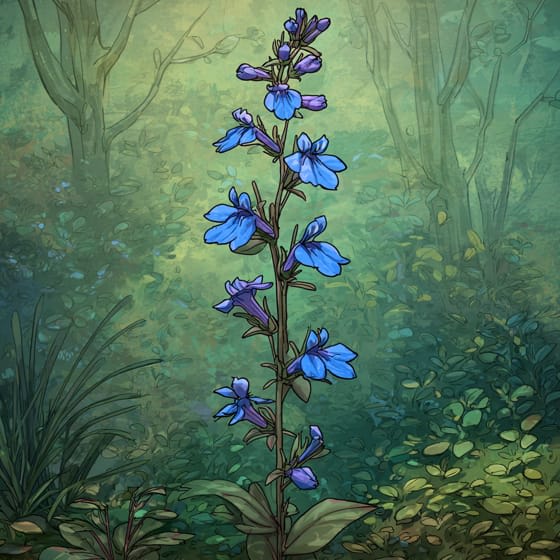





Lobelia
Lobelia erinus
Lobelia produces beautiful blue and purple flowers that look like tiny bells. They are perfect for hanging baskets!
Habitat: Gardens and containers
The Lobelia has an abundance of tiny, vibrant blue, purple, or white flowers with contrasting white 'eyes'. Its delicate stems form a low-growing or trailing mound, creating a colourful carpet or waterfall of blooms that really stand out.
Category
PlantsRarity
Common
Danger
1/5 · Very low
Snaps
Be the first to snap!
Even though they look delicate, some Lobelia can survive chilly weather, even a light frost!
Lobelia's teeny-tiny seeds are sometimes so small, you need a magnifying glass to see them!
Some Lobelia species can grow huge, reaching over 6 feet tall, towering like flowery giants!
The name 'Lobelia' honors a famous plant explorer, Matthias de l'Obel, who loved plants!
Lobelia has brightly colored, nectar-rich flowers that attract busy bees and butterflies, helping the plant make new seeds.
Lobelia contains special compounds called alkaloids that make it taste bitter or harmful, protecting it from hungry munching animals.
Lobelia can quickly re-bloom after old flowers fade, helping it produce many seeds and spread its plant babies widely.
Apis mellifera
Collects nectar and pollen for its hive.
Vanessa cardui
Sips nectar, carrying pollen to other flowers.
Arion lusitanicus
Munching on leaves, especially young Lobelia plants.
Bell-shaped flowers possess petals fused or arranged to form a cup-like or campanulate structure resembling a bell.
Shade tolerant plants are adapted to grow and thrive in areas with low light levels, requiring less direct sunlight.
Spring blooming plants produce their flowers during the spring season, often signifying the end of winter and the start of new growth.
A tube flower has petals fused together at the base, forming a distinct tubular structure that typically holds nectar deep within.

Fragrant flowers emit a pleasant aroma, often to attract pollinators or for defense.

This habitat trait indicates species that can coexist with humans in urban and suburban environments, utilizing man-made structures and green spaces.
Danger
1/5 · Very low
Explore with care and ask an adult if you’re unsure what to do.
The easiest way to identify Lobelia is to use the Snappit nature identifier app.
10-20 cm
15-30 cm
1-2 cm
Spring to Autumn
No
Moderate
Annual
Zoom in to split clusters and explore where this object has been snapped.
Recent snaps will appear here as new observations are added.
Take the discovery with you
Snap it with Snappit to identify it, learn what makes it special, and add the discovery to your collection.









.jpg&width=800)


_001.jpg&width=800)



