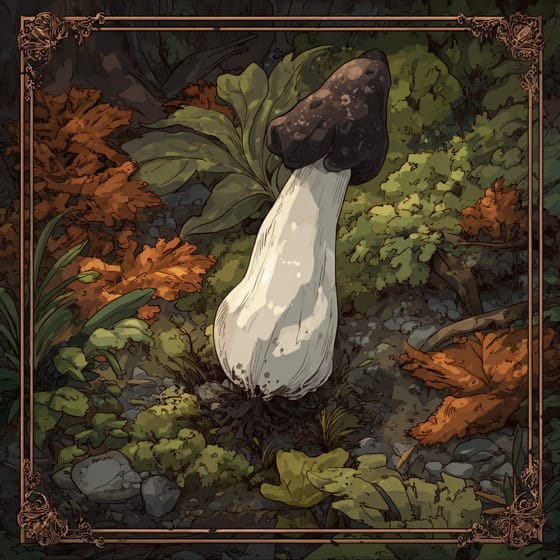





Stinkhorn
Phallus
The Stinkhorn fungus has a funny shape and a strong smell! It grows in the ground and is very unusual to see.
Habitat: In gardens and forests
The Stinkhorn is a striking fungus with a tall, white, porous stalk topped by a conical, slimy, olive-green cap. This cap is covered in a dark, foul-smelling goo (gleba) that makes it visually distinct from most other tall, stalked mushrooms.
Category
FungiRarity
Rare
Danger
1/5 · Very low
Snaps
1
Ancient Europeans believed Stinkhorns grew where lightning had struck!
Before emerging, Stinkhorns look like a soft, white 'witch's egg' buried in the soil!
Its scientific name, 'Phallus', comes from its unusual, phallic shape!
Some people brave the smell and eat the Stinkhorn 'egg' when it's still young!
Stinkhorn can produce a strong, foul odor because of its slimy spore mass that helps them attract flies for spore dispersal.
Stinkhorn has a unique 'egg' stage that helps them rapidly emerge from the ground, sometimes in just hours, after heavy rain.
Stinkhorn has sticky, smelly spores that help them hitch a ride on visiting insects, spreading them far and wide.
Calliphora vicina
Blowflies are attracted to and feed on the smelly gleba, dispersing spores.
Quercus robur
Stinkhorns decompose dead wood and leaf litter from trees like oak.

Arion ater
Slugs occasionally feed on the foul-smelling spore mass (gleba).
Spore-producing organisms reproduce by releasing small, often single-celled, reproductive units called spores.
Rapid growing plants exhibit accelerated growth rates, quickly increasing in size and biomass within a short period.
Forest habitats are terrestrial environments dominated by dense tree cover, supporting a high diversity of plant and animal life.
Danger
1/5 · Very low
Do not pick or eat anything you find. Some plants and mushrooms can be harmful.
The easiest way to identify Stinkhorn is to use the Snappit nature identifier app.
10-30 cm
inedible
2-4 cm
In gardens and forests
soil
Summer to fall
Olive-green
Zoom in to split clusters and explore where this object has been snapped.
Take the discovery with you
Snap it with Snappit to identify it, learn what makes it special, and add the discovery to your collection.