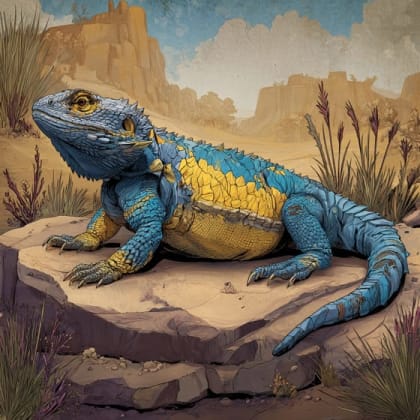

Draco Lizard
Draco volans
The Draco Lizard, also known as the Flying Dragon, has special wings that allow it to glide from tree to tree. It's a master of the treetops, blending in with its surroundings.
Habitat: Forest
The Draco Lizard has an elongated, flattened body, typically olive-green or brown, with distinctive, brightly colored 'wings' (patagia) that fold up like a fan when not in use. Males often have a vivid yellow or orange dewlap, while females have a smaller blue or grey one.
Category
ReptilesRarity
Common
Danger
2/5 · Low
Snaps
Be the first to snap!
Draco lizards use their tails to steer while gliding through the forest air!
Female Draco lizards dig nests in soft soil to protect their precious eggs.
Some 'flying dragon' species have bright blue, red, or yellow underwings!
They can flatten their bodies to become more aerodynamic for flight!
Draco Lizard can glide between trees because of large skin flaps stretched over elongated ribs that help them escape predators and find mates.
Draco Lizard has excellent camouflage that helps them blend perfectly with tree bark, making them almost invisible to predators and prey.
Draco Lizard can flash its vibrant dewlap and wing colors because of specialized skin pigments that help them attract mates and defend territory.
Tiny tree-dwelling insect-eaters, they snack mostly on ants and termites found on tree bark.
Oecophylla smaragdina
Consumes these ants from tree trunks.
Macrotermes gilvus
Feeds on termite colonies found on tree bark.
Chrysopelea ornata
A primary predator that hunts in the trees.
Spizaetus cirrhatus
Bird of prey snatching them from canopy.
Aerial creatures spend a significant portion of their lives airborne, utilizing flight for various activities such as hunting, migration, or nesting.
Arboreal animals live primarily in trees, utilizing them for shelter, food, and protection from predators.
Camouflaged describes organisms that possess coloring or patterns that allow them to blend into their environment.
Gliding animals move through the air by launching themselves and maintaining flight with specialized body structures, without flapping wings.

This trait identifies organisms whose diet primarily consists of insects and other small invertebrates.

This trait signifies organisms belonging to a very old evolutionary group with ancestors dating back millions of years.

Forest habitats are terrestrial environments dominated by dense tree cover, supporting a high diversity of plant and animal life.
Regenerative organisms possess the ability to regrow lost or damaged body parts, tissues, or organs.
Danger
2/5 · Low
Observe from a safe distance and never try to catch or handle wild animals.
19-23 cm
0.005-0.015 kg
2-5 years
5 km/h
Tiny tree-dwelling insect-eaters, they snack mostly on ants and termites found on tree bark.
Forest
Foraging
2-4
Zoom in to split clusters and explore where this object has been snapped.
Recent snaps will appear here as new observations are added.