



Australian Shepherd
Canis lupus familiaris
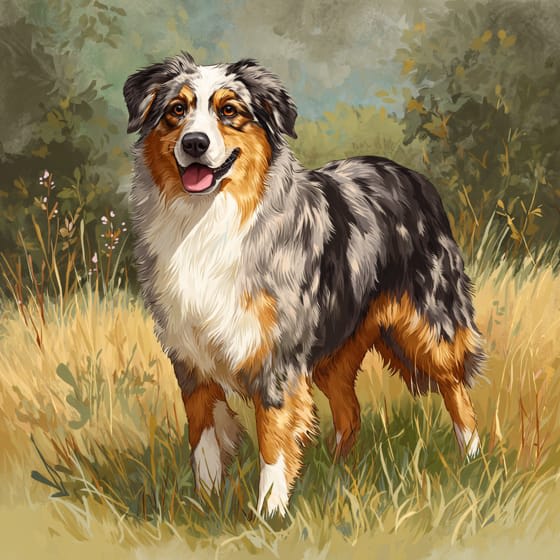
An Australian Shepherd is an energetic herding dog that loves to work and play. Many have speckled, merle coats.
Habitat: Farms and active homes; wide parks and trails
The Australian Shepherd has a medium-length, often striking merle coat in blue or red, or solid black or red, with white and tan markings. Its intelligent eyes can be brown, blue, amber, or even two different colors (heterochromia), adding to its unique look. Its tail is naturally bobbed or docked.
Category
MammalsRarity
Common
Danger
2/5 · Low
Snaps
Be the first to snap!
Despite their name, Australian Shepherds were actually developed in the western USA!
Some Aussies are born with a naturally short or 'bobbed' tail, instead of a long one!
Their stunning merle coat pattern means no two Australian Shepherds look exactly alike!
They often choose one person in the family to bond with most, becoming a true 'velcro dog'!
Australian Shepherds can use an intense stare that helps them control and direct livestock with precision.
Australian Shepherds have incredible agility and speed because of their athletic build, helping them change direction fast.
Australian Shepherds have high intelligence that helps them quickly learn complex tasks and commands.
These omnivores primarily eat specially formulated dog food, supplemented with occasional treats.
Homo sapiens
They are companion animals and working partners for people.
Ovis aries
They were originally bred to herd sheep, guiding them efficiently.
Bos taurus
Australian Shepherds also herd cattle on farms and ranches.
Furry describes animals possessing a dense covering of soft hair or fur.
Social animals live in organized groups, cooperating for survival benefits such as foraging, defense, and raising offspring.
This trait identifies organisms whose diet includes both plant and animal matter.
This trait describes organisms that manipulate external objects to achieve a specific goal.

Domesticated refers to species that have been selectively bred and tamed by humans for specific purposes.

Describes a species whose presence and role have a disproportionately large effect on its environment.

This trait identifies organisms that exhibit exceptional swiftness in movement for hunting, escape, or travel.

This habitat trait indicates species that can coexist with humans in urban and suburban environments, utilizing man-made structures and green spaces.
Danger
2/5 · Low
Play running games in open spaces, not near roads; always with an adult.
46-58 cm
18-29 kg
12-15 years
45 km/h
These omnivores primarily eat specially formulated dog food, supplemented with occasional treats.
Farms and active homes; wide parks and trails
4-9
58-68 days
Zoom in to split clusters and explore where this object has been snapped.
Recent snaps will appear here as new observations are added.