Snapdragon
Antirrhinum majus
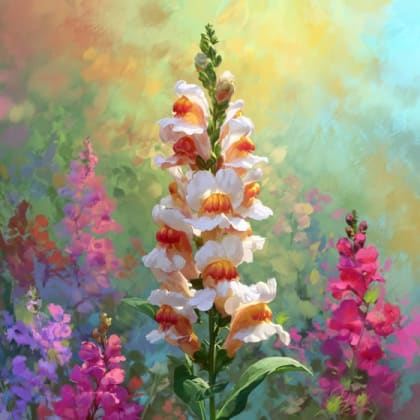
Snapdragons are colorful flowers that look like little dragon faces! When you squeeze the sides, they open and close, just like a dragon's mouth. They come in many bright colors and are fun to see in gardens.
Habitat: Gardens
The Snapdragon has tall, upright stalks adorned with tubular flowers that resemble a dragon's mouth or a gaping face. These vibrant blooms come in almost every color except true blue, often featuring striking bicolor patterns and a unique 'snapping' motion when squeezed.
Category
PlantsRarity
Common
Danger
1/5 · Very low
Snaps
1
Its name, Antirrhinum, means "like a snout" in ancient Greek!
Snapdragons were once believed to have magical protective powers!
Some snapdragons can survive light frosts and keep blooming.
The flower's unique "snap" sound amused gardeners for centuries.
Snapdragon's "mouth" flowers are perfectly shaped to be opened by heavy bumblebees, helping it control who pollinates it.
After blooming, the seed pods dry into shapes uncannily like tiny human skulls, protecting the seeds inside.
It has extremely bright, diverse flower colors and patterns that attract specific insect pollinators from far away.
Bombus terrestris
Large bees are strong enough to open the flower mouth.
Agrius convolvuli
Caterpillars feed on the foliage.
Pieris rapae
Caterpillars munch on leaves and flowers.
Flowering plants are any plants that produce flowers as part of their reproductive cycle.
Ornamental plants are cultivated primarily for their aesthetic appeal, enhancing landscapes and gardens with their attractive foliage, flowers, or form.
Spring blooming plants produce their flowers during the spring season, often signifying the end of winter and the start of new growth.
Summer blooming plants produce their flowers during the summer season, often providing vibrant color when many other plants have finished.

A tube flower has petals fused together at the base, forming a distinct tubular structure that typically holds nectar deep within.

Colorful describes organisms or objects displaying a wide range of bright and distinct colors.

Describes plants that are particularly attractive and beneficial to a wide range of pollinating organisms.

This habitat trait indicates species that can coexist with humans in urban and suburban environments, utilizing man-made structures and green spaces.
Danger
1/5 · Very low
Always ask an adult before picking flowers, and remember to smell them gently!
30-120 cm
15-45 cm
3-5 cm
Late spring to first frost
No
Mild
Perennial
Insect
Zoom in to split clusters and explore where this object has been snapped.