

Akeake
dodonaea viscosa
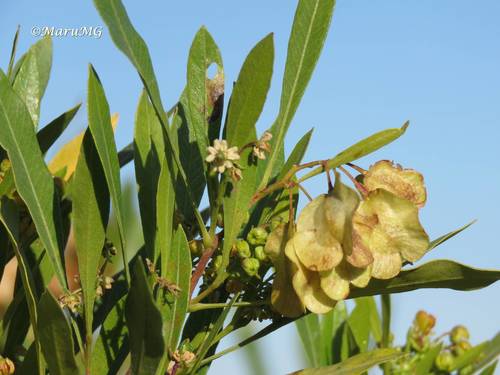
Akeake (Dodonaea viscosa), auch bekannt als Hopfenstrauch, ist ein robuster und vielseitiger immergrüner Strauch oder kleiner Baum, der in Neuseeland, Australien und anderen tropischen und subtropischen Regionen beheimatet ist. Berühmt für seine extreme Widerstandsfähigkeit, bedeutet sein Maori-Name 'Akeake' 'für immer und ewig', was auf seine zähe Natur und seine Fähigkeit hinweist, in rauen Küstenumgebungen, trockenen Böden und starken Winden zu überleben. Er spielt eine wichtige Rolle bei der ökologischen Wiederherstellung, indem er schnell gestörten Boden besiedelt und anderen einheimischen Pflanzen Schutz zur Etablierung bietet. In der traditionellen Maori-Kultur wurde sein unglaublich dichtes, schweres Holz für die Herstellung von langlebigen Waffen, Grabstöcken und Wanderstöcken geschätzt.
Lebensraum: Typischerweise in Küstendünen, Tieflandwäldern, offenen Buschlandschaften und felsigen Klippen zu finden, wo er salzige Winde und karge Böden verträgt.
Akeake wächst typischerweise als vielverzweigter Strauch oder kleiner Baum und erreicht Höhen von 2 bis 9 Metern. Er besitzt einfache, hellgrüne bis bronzegrüne, schmale Blätter, die wechselständig angeordnet sind und eine klebrige, harzige Substanz absondern, die ihnen ein leicht glänzendes Aussehen verleiht. Im Frühling und Sommer produziert er kleine, unauffällige grünlich-gelbe Blüten ohne Blütenblätter, die sich zu sehr charakteristischen, papierartigen, zwei- bis vierflügeligen Samenkapseln entwickeln. Diese Samenkapseln reifen von einem hellgrünen oder cremefarbenen Gelb zu einem trockenen Hellbraun, ähneln Hopfen und werden leicht vom Wind verbreitet.
Kategorie
PflanzenSeltenheit
Common
Gefahr
1/5 · Sehr gering
Snaps
1
Akeake-Holz ist eines der dichtesten und schwersten aller neuseeländischen heimischen Bäume, so schwer, dass es im grünen Zustand im Wasser sinkt.
Frühe europäische Siedler in Australien und Neuseeland verwendeten die geflügelten Samenkapseln dieser Pflanze als Hopfenersatz beim Bierbrauen, was ihr den Trivialnamen 'Hopfenstrauch' einbrachte.
Der Maori-Name 'Akeake' bedeutet 'für immer und ewig' und verweist auf die unglaubliche Stärke und Haltbarkeit des Holzes.
Sondert einen klebrigen, harzigen Film über seine Blätter ab, der den Wasserverlust minimiert und die Pflanze vor Salzsprühnebel und intensiver UV-Strahlung schützt.
Produziert leichte, papierartige, geflügelte Samenkapseln, die als Segel wirken und es dem Wind ermöglichen, Samen über weite Strecken zu transportieren, um neue Gebiete zu besiedeln.
Besitzt flexible Äste und zähes, lederartiges Laub, das starken Stürmen und stark salzhaltigen Küstenumgebungen standhält, wo andere Bäume versagen.
Als photosynthetische Pflanze erzeugt Akeake ihre eigenen organischen Nährstoffe aus Sonnenlicht, Kohlendioxid und Wasser, während sie essentielle Mineralien über ihr Wurzelsystem aufnimmt.
Aenetus virescens
Die Raupen dieser Motte ernähren sich vom Holz des Akeake und bohren Gänge in die Stängel.
Anthornis melanura
Ernährt sich vom Nektar der Akeake-Blüten und hilft bei der Bestäubung.
Vitex lucens
Akeake bietet Schutz und Kronendeckung und unterstützt die Keimung und das Wachstum langsamer wachsender Kronenbäume wie des Puriri.
Für dieses Objekt sind noch keine Merkmal-Badges vergeben.
Noch keine Alternativnamen vorhanden.
Sammlungen für dieses Objekt erscheinen hier, wenn weitere Themen hinzugefügt werden.
Gefahr
1/5 · Sehr gering
Noch keine besonderen Sicherheitshinweise.
Der einfachste Weg, Akeake zu bestimmen, ist die Verwendung der Naturführer-App Snappit.
200-900 cm
15-60 Jahre
Als photosynthetische Pflanze erzeugt Akeake ihre eigenen organischen Nährstoffe aus Sonnenlicht, Kohlendioxid und Wasser, während sie essentielle Mineralien über ihr Wurzelsystem aufnimmt.
Typischerweise in Küstendünen, Tieflandwäldern, offenen Buschlandschaften und felsigen Klippen zu finden, wo er salzige Winde und karge Böden verträgt.
Zoome hinein, um Cluster aufzulösen und zu sehen, wo dieses Objekt fotografiert wurde.
Nimm die Entdeckung mit
Fotografiere deinen Fund mit Snappit, bestimme die Art und füge die Entdeckung deiner Sammlung hinzu.












.jpg&width=800)



_001.jpg&width=800)




