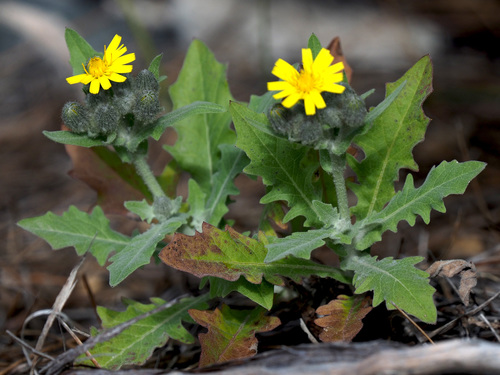


Andryala Pinnatifida
andryala pinnatifida
Andryala pinnatifida ist ein auffälliger mehrjähriger Halbstrauch, der auf den Kanarischen Inseln endemisch ist. Diese widerstandsfähige Pflanze, die zur Familie der Korbblütler (Asteraceae) gehört, hat sich hervorragend an die vulkanischen Terrains und die unterschiedlichen Mikroklimata des Archipels angepasst. Sie ist lokal für ihre weiche, samtige Textur bekannt und gedeiht an felsigen Hängen, in offenen Kiefernwäldern und im Buschland, wo sie den rauen Landschaften einen silbergrauen Touch verleiht. Ihre leuchtend gelben Korbblüten stehen in starkem Kontrast zu ihrem blassen Laub und sind ein Favorit unter einheimischen Bestäubern wie Wildbienen und Schmetterlingen. Diese Art spielt eine wichtige Rolle in der lokalen Ökologie, indem sie vulkanische Böden besiedelt und dazu beiträgt, Erosion in empfindlichen Inselökosystemen zu verhindern.
Lebensraum: Man findet sie hauptsächlich an felsigen Vulkanhängen, an Straßenrändern und in offenen Kiefernwäldern der Kanarischen Inseln.
Diese Pflanze ist leicht an ihren tief gelappten, fiederteiligen Blättern zu erkennen, die mit einer dichten Decke aus sternförmigen, weißlichen bis gelblichen Drüsenhaaren bedeckt sind, was der gesamten Pflanze ein ausgeprägtes samtiges, graugrünes oder silbernes Aussehen verleiht. Sie wächst typischerweise als aufrechte Staude oder kleiner Halbstrauch und erreicht eine Höhe von 30 bis 80 cm. Während ihrer Blütezeit bildet sie endständige Büschel leuchtend gelber Blütenköpfe (Capitula), die Löwenzahn ähneln und jeweils etwa 2 bis 3 cm im Durchmesser messen, sitzend auf behaarten, verzweigten Stängeln.
Kategorie
PflanzenSeltenheit
Common
Gefahr
1/5 · Sehr gering
Snaps
Mach den ersten Snap!
Sie ist eine äußerst widerstandsfähige Pionierpflanze, oft eine der ersten Arten, die nach Vulkanausbrüchen auf frischer Vulkanasche keimt.
Ihre dicke, pelzige Beschichtung verleiht ihr eine bemerkenswert weiche, filzähnliche Textur, die Einheimische manchmal als Pflanzenwolle bezeichnen.
Der Artname 'pinnatifida' bezieht sich auf ihre tief gelappten, federartigen Blätter.
Als photoautotrophe Pflanze produziert sie ihre eigene Energie, indem sie Sonnenlicht, Kohlendioxid, Wasser und Bodenmineralien durch Photosynthese in Zucker umwandelt.
Bombus canariensis
Bietet Nektar und Pollen für diese endemische Kanaren-Hummel.
Gallotia galloti
Wird gelegentlich von endemischen Eidechsen abgeweidet, die in ariden Zonen Feuchtigkeit und Nährstoffe suchen.
Für dieses Objekt sind noch keine Merkmal-Badges vergeben.
Noch keine Alternativnamen vorhanden.
Sammlungen für dieses Objekt erscheinen hier, wenn weitere Themen hinzugefügt werden.
Gefahr
1/5 · Sehr gering
Noch keine besonderen Sicherheitshinweise.
Der einfachste Weg, Andryala Pinnatifida zu bestimmen, ist die Verwendung der Naturführer-App Snappit.
30-80 cm
2-5 Jahre
Als photoautotrophe Pflanze produziert sie ihre eigene Energie, indem sie Sonnenlicht, Kohlendioxid, Wasser und Bodenmineralien durch Photosynthese in Zucker umwandelt.
Man findet sie hauptsächlich an felsigen Vulkanhängen, an Straßenrändern und in offenen Kiefernwäldern der Kanarischen Inseln.
Zoome hinein, um Cluster aufzulösen und zu sehen, wo dieses Objekt fotografiert wurde.
Neueste Snaps erscheinen hier, wenn neue Beobachtungen hinzukommen.
Nimm die Entdeckung mit
Fotografiere deinen Fund mit Snappit, bestimme die Art und füge die Entdeckung deiner Sammlung hinzu.








.jpg&width=800)



_001.jpg&width=800)




