Catalpas
Catalpa
Catalpas are beautiful trees with big, heart-shaped leaves and lovely white flowers. They can grow very tall and provide shade for people and animals alike.
Lebensraum: Urban areas, forests
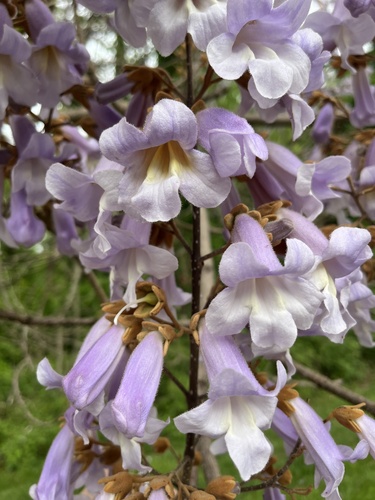
The Catalpas has very large, heart-shaped bright green leaves and distinctive bell-shaped white flowers often spotted with yellow and purple. Its most unique feature is long, slender, bean-like pods that hang from branches, persisting through winter.
Kategorie
PflanzenSeltenheit
Common
Gefahr
1/5 · Sehr gering
Snaps
Mach den ersten Snap!
Catalpa wood is naturally rot-resistant, making it super strong!
Its giant heart-shaped leaves are some of the biggest on any tree!
Long seed pods, called 'Indian beans,' can hang like noodles all winter!
Some people call it the 'Cigar Tree' because of its long, thin fruit.
Catalpas has huge leaves that provide ample shade, helping it conserve water and cool its surroundings.
Catalpas develops long seed pods that split open to release winged seeds, helping it spread far.
Catalpas has showy, nectar-rich flowers that attract many insects, ensuring successful pollination.
Catalpas has tough, rot-resistant wood that helps it withstand harsh weather and pests for many years.
Bombus impatiens
Visits flowers for nectar
Ceratomia catalpae
Larvae feed on Catalpa leaves
Turdus migratorius
Nests in the dense canopy
Sciurus carolinensis
May eat seeds from pods
Blütenpflanzen sind alle Pflanzen, die als Teil ihres Fortpflanzungszyklus Blüten bilden.
Laubabwerfende Pflanzen werfen regelmäßig all ihre Blätter ab, typischerweise im Herbst oder in Trockenzeiten.
Frühlingsblüher bilden ihre Blüten im Frühjahr und kündigen oft das Ende des Winters und den Beginn neuen Wachstums an.
Schattenverträgliche Pflanzen sind an das Wachstum und Gedeihen in Bereichen mit wenig Licht angepasst und benötigen weniger direkte Sonneneinstrahlung.

Laubbäume sind Bedecktsamer, die sich durch flache, breite Blätter auszeichnen, welche in gemäßigten Klimazonen typischerweise jährlich abgeworfen werden.

Beschreibt Pflanzen, die für eine Vielzahl von bestäubenden Organismen besonders attraktiv und nützlich sind.

Waldlebensräume sind terrestrische Lebensräume, die von dichtem Baumbestand dominiert werden und eine große Vielfalt an Pflanzen- und Tierarten beherbergen.

Dieses Lebensraummerkmal weist auf Arten hin, die in städtischen und vorstädtischen Umgebungen mit Menschen zusammenleben können und von Menschen geschaffene Strukturen sowie Grünflächen nutzen.
Gefahr
1/5 · Sehr gering
Always stay on paths when exploring around trees to avoid tripping.
1000-1800 cm
600-1200 cm
3-5 cm
Late spring to early summer
Nein
Leicht
Mehrjährig
Insekten
Zoome hinein, um Cluster aufzulösen und zu sehen, wo dieses Objekt fotografiert wurde.
Neueste Snaps erscheinen hier, wenn neue Beobachtungen hinzukommen.
Pennsylvania, US
Hier kann man sehen Paulownia, Asiatischer Marienkäfer und Spotted Lanternfly.
Führer anzeigen →

District of Columbia, US
Hier kann man sehen östliches Grauhörnchen, Biene und Purpletop Vervain.
Führer anzeigen →