
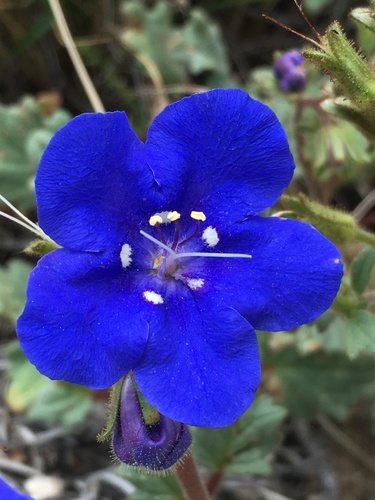


Charlottes Phacelia
phacelia nashiana
Charlottes Phacelia (Phacelia nashiana) ist eine faszinierende einjährige Wildblume, die in den ariden und semi-ariden Regionen Südkaliforniens endemisch ist. Oft an den kiesigen Hängen zu finden, wo sich die südliche Sierra Nevada in die Mojave-Wüste verwandelt, erwacht diese widerstandsfähige kleine Pflanze im Frühling zum Leben. Sie wird von Botanikern und Wanderern gleichermaßen für ihre auffallenden, intensiv blauen Blüten bewundert, die einen lebhaften Kontrast zu den sandigen, gedeckten Wüstenböden bilden. Als Einjährige ist sie stark auf rechtzeitige Winterregen angewiesen, um zu keimen und den Wüstenboden in ein kobaltblaues Meer zu verwandeln, was ihre saisonalen Auftritte sowohl kostbar als auch mit Spannung erwartet macht. Über ihre reine Schönheit hinaus spielt Charlottes Phacelia eine wichtige ökologische Rolle, indem sie als entscheidende Nektarquelle für einheimische Wüstenbestäuber dient, wenn nur wenige andere Ressourcen verfügbar sind.
Lebensraum: Findet sich in trockenen, sandigen oder kiesigen Böden an Wüstenhängen, in Pinyon-Juniper-Wäldern und Joshua-Baum-Wäldern.
Diese niedrig wachsende krautige Einjährige erreicht typischerweise Höhen von 5 bis 20 Zentimetern und besitzt aufrechte, behaarte Stängel, die sich nahe der Basis verzweigen können. Die Blätter sind tief gelappt oder geteilt und mit feinen, borstigen Haaren bedeckt, die ihnen eine leicht gräulich-grüne Textur verleihen. Ihr auffälligstes Merkmal ist die atemberaubende, glocken- oder schalenförmige Blüte, die einen außergewöhnlich intensiven tiefblauen bis violettblauen Farbton aufweist. Jede fünfgelappte Blüte misst etwa 1 bis 1,5 Zentimeter im Durchmesser und zeigt oft ein blasses oder weißes Zentrum, geschmückt mit prominenten Staubblättern, die elegant aus dem Kelch ragen.
Kategorie
PflanzenSeltenheit
Gewöhnlich
Gefahr
1/5 · Sehr gering
Snaps
Mach den ersten Snap!
Charlottes Phacelia ist nach Charlotte N. Smith benannt, einer aktiven Amateur-Botanikerin, die Mitte des 20. Jahrhunderts Pflanzen in Kalifornien sammelte.
Sie ist eine 'Feuerfolgepflanze' oder störungsangepasste Art, die manchmal in riesigen, spektakulären Zahlen im Frühling nach einem Wüstenbrand auftritt.
Einige Phacelia-Arten sind als 'Skorpionsunkräuter' bekannt, weil ihre sich entrollenden Blütenstände einem Skorpionsschwanz ähneln, obwohl Phacelia nashiana relativ kompakt ist.
Als photoautotrophe Pflanze produziert Charlottes Phacelia ihre eigene Nahrung durch Photosynthese, wobei sie Sonnenlicht, Kohlendioxid und Wasser nutzt.
Bombus crotchii
Wird von einheimischen solitären Bienen bestäubt, die nach Nektar und Pollen suchen.
Gopherus agassizii
Bietet Laub, das gelegentlich von Wüstenschildkröten abgefressen werden kann.
Für dieses Objekt sind noch keine Merkmal-Badges vergeben.
Noch keine Alternativnamen vorhanden.
Sammlungen für dieses Objekt erscheinen hier, wenn weitere Themen hinzugefügt werden.
Gefahr
1/5 · Sehr gering
Noch keine besonderen Sicherheitshinweise.
Beginne mit der ganzen Pflanze und vergleiche dann Blattstellung, Blattränder, Stängel und eventuelle Blüten oder Früchte. Gegenständige Blätter wachsen paarweise, wechselständige einzeln am Stängel. Zusammen verraten diese Details weit mehr als ein einzelnes grünes Blatt. Pflanzen bestimmen: Lade ein Foto hoch und vergleiche die sichtbaren Merkmale.
5-30 cm
1 Jahre
Als photoautotrophe Pflanze produziert Charlottes Phacelia ihre eigene Nahrung durch Photosynthese, wobei sie Sonnenlicht, Kohlendioxid und Wasser nutzt.
Findet sich in trockenen, sandigen oder kiesigen Böden an Wüstenhängen, in Pinyon-Juniper-Wäldern und Joshua-Baum-Wäldern.
Zoome hinein, um Cluster aufzulösen und zu sehen, wo dieses Objekt fotografiert wurde.
Neueste Snaps erscheinen hier, wenn neue Beobachtungen hinzukommen.
Nimm die Entdeckung mit
Fotografiere deinen Fund mit Snappit, bestimme die Art und füge die Entdeckung deiner Sammlung hinzu.


















